Some links on this page are affiliate links: we may earn a commission if you buy, and your price doesn't change. Details
Water Freedom System: A $39.69 step-by-step guide (PDF and videos) to building a home water-from-air unit around a store-bought dehumidifier, plus four bonus books.
See the Water Freedom System guide on the official site60-day money-back guarantee
Start here
This hub maps every way to make water from air, so start with the page that matches your question.
- Water from air methods and machines: the full menu, from fog nets to plug-in units.
- How AWGs work, step by step: the parts inside and what each one does.
- Our picks for a home atmospheric water generator: ready-made units compared on published specs.
- Building your own AWG: what a home build involves and where it falls short.
Ways to make water from air, compared
| Method | Humidity it needs | Power | Water use | Best fit |
|---|---|---|---|---|
| Compressor AWG | Moderate to high, warm | Grid, high draw | Built-in filters and UV; follow the maker’s schedule | Humid homes wanting tap-like water |
| Desiccant AWG | Can work in drier air | Heat, often high | Built-in treatment; follow the maker’s schedule | Drier sites with spare heat or solar |
| Dehumidifier DIY | Moderate to high | Grid, high draw | Plants, cleaning and flushing only | Tinkerers with humid basements |
| Fog and dew nets | Frequent fog or heavy dew | None | Non-drinking uses unless tested and treated | Foggy coasts and ridges |
The best choice depends on where you live. Humid Southeast homes do best with compressor units, while dry inland homes may get more from rain barrels.
What is an atmospheric water generator and how does it make water from air?
An atmospheric water generator is a machine that pulls water vapor from the air and turns it into liquid water you can collect and store.
Picture a cold glass of iced tea on a humid July porch. Beads of water form on the outside. Nobody spilled anything. The cold glass chilled the nearby air, and the air let go of its moisture. An AWG does that on purpose, all day.
The idea is called atmospheric water harvesting. It covers big machines, small plug-in units and simple nets that catch fog. People look to it during drought and water scarcity, and for extra water at home.
Condensation: the cooling method
Condensation units, the most common kind, chill air below the temperature at which it drops its water (the dew point). The steps run like this:
- A fan draws air in through a dust filter.
- The air passes over a cold coil cooled by a compressor, like a fridge.
- Water drips off the coil into a tray.
- The water runs through filters and often a UV lamp.
- It sits in a storage tank until you pour it.
Most AWGs pull moisture from air much the way a household dehumidifier does, with condenser coils and fans.
Desiccant (adsorption) units: the silica gel method
Desiccant units grab water with a drying material, such as silica gel, then use heat to release it. Sticking water to a surface is called adsorption; driving it back off with heat is desorption.
Think of the little silica gel packets in a shoe box. They soak up moisture. Warm them, and they give it back as vapor, which is then cooled into water. This can work in drier air than a cold coil handles, but heating the material takes energy, and home desiccant units are less common.
Fog and dew harvesting without power
Fog and dew harvesting uses mesh nets or cool surfaces to catch water with no electricity at all. It suits foggy coasts and mountain ridges where fog rolls through often. Yields depend entirely on local weather.
Israel gets asked about a lot here. Companies based there, Watergen among them, have built condensation machines for homes, trucks and towns. Most projects around the world, in Israel and elsewhere, run at small or pilot scale rather than replacing a town’s main supply.
Do atmospheric water generators actually work in dry climates?
Atmospheric water generators work in dry climates only weakly, because output falls sharply as humidity and temperature drop.
That’s the honest answer for much of the Southwest. A unit that fills its tank in a muggy Gulf Coast summer may barely drip in Phoenix in June, even though it’s hot.
How much water to expect at different humidity levels
AWG output depends on how much water the air holds, which comes from both humidity and temperature. Warm, sticky air gives the most. Mild air gives less, and cool or dry air may give little to nothing from many compressor units.
Makers usually state water output (gallons per day) at warm, humid test conditions. Always find the temperature and humidity behind the number.
Quick tip: Buy an inexpensive hygrometer and log your indoor humidity for a few weeks before you spend money on any unit.
Why low humidity and cold weather cut output
Low humidity and cold air cut output because the coil must get colder to reach the dew point, and below freezing the coil frosts instead of dripping. Dry air also means the fan moves a lot of air for very little water, so you pay more power for less.
How much does it cost to generate atmospheric water?
Atmospheric water costs you three ways: the purchase price, the electricity for every gallon, and filters and upkeep.
Purchase price ranges
AWG prices vary widely by maker and size. Countertop and home units often run from several hundred to a few thousand dollars. Larger whole-home and commercial units cost far more and usually need professional setup. Check current prices from the seller, since they change.
Electricity per liter versus tap water
AWG electricity cost is simple math: energy per liter times your power rate. Energy consumption is the big running cost, since the condenser and fans can draw a lot of power, though designs have improved.
Here’s a worked example to redo with your own numbers:
| Step | Example figure | Your figure |
|---|---|---|
| Unit’s stated energy use | 0.5 kWh per liter (example only) | from spec sheet |
| Your power rate | $0.16 per kWh (example only) | from your bill |
| Cost per liter | 0.5 × 0.16 = $0.08 | |
| Cost per gallon (3.785 L) | about $0.30 |
Those example figures are placeholders, not a promise. Real energy use climbs in drier air. For comparison, city tap water usually costs well under a cent per gallon, and rainwater from a barrel costs little to collect once the gear is bought. Run your own numbers before counting on any cost savings.
Filter and maintenance costs
AWG maintenance means replacement filters, cleaning the tank and coil, and sometimes a new UV lamp. Budget for these every year. Solar power can offset electricity, but a compressor unit needs a sizeable panel and battery setup to run well.
Is it safe to drink atmospheric water?
Water quality depends on the machine. A finished drinking-water generator treats its own water, so follow the maker’s instructions and filter schedule. Water straight off a coil isn’t safe by default.
Why condensed water is not automatically safe
Condensed water picks up dust, microbes and whatever is in the air. Coils, solder, drip pans and plastics that aren’t food-grade can add metals or chemicals. Stored water can also grow bacteria, which is why finished units use built-in treatment and why a clean tank matters.
Filtration, UV and carbon stages in finished units
Good AWG treatment uses several stages working together:
- Sediment filter: catches dust and grit.
- Activated carbon: a porous charcoal that grabs many chemicals and odors.
- UV sterilization: ultraviolet light that damages germs as water passes by.
- Disinfection in storage: some units recirculate water past UV to keep the storage tank clean.
A dirty tank undoes all of it. Follow the maker’s cleaning and filter schedule.
Dehumidifier and home-build water
Until a certified lab test confirms it, use water from a dehumidifier or home build for plants, cleaning and toilet flushing. Boiling, bleach and household filters kill germs or catch particles, but they don’t remove metals or chemicals picked up from coils, solder, drip pans or ordinary plastics. It only becomes a drinking option if every part the water touches is drinking-water safe, the treatment matches what’s actually in the water (for example, a filter certified to NSF/ANSI 53 for lead), and a certified lab test confirms it.
Minerals and remineralization
Condensed water has very few minerals, much like distilled water, so it can taste flat. Some units add a mineral cartridge. Remineralizing is mostly about taste; your food is where most minerals come from.
What ready-made options exist, and is there one made in the USA?
Ready-made AWGs come in countertop, home and commercial sizes, and a few US companies build or assemble them.
Countertop and home units
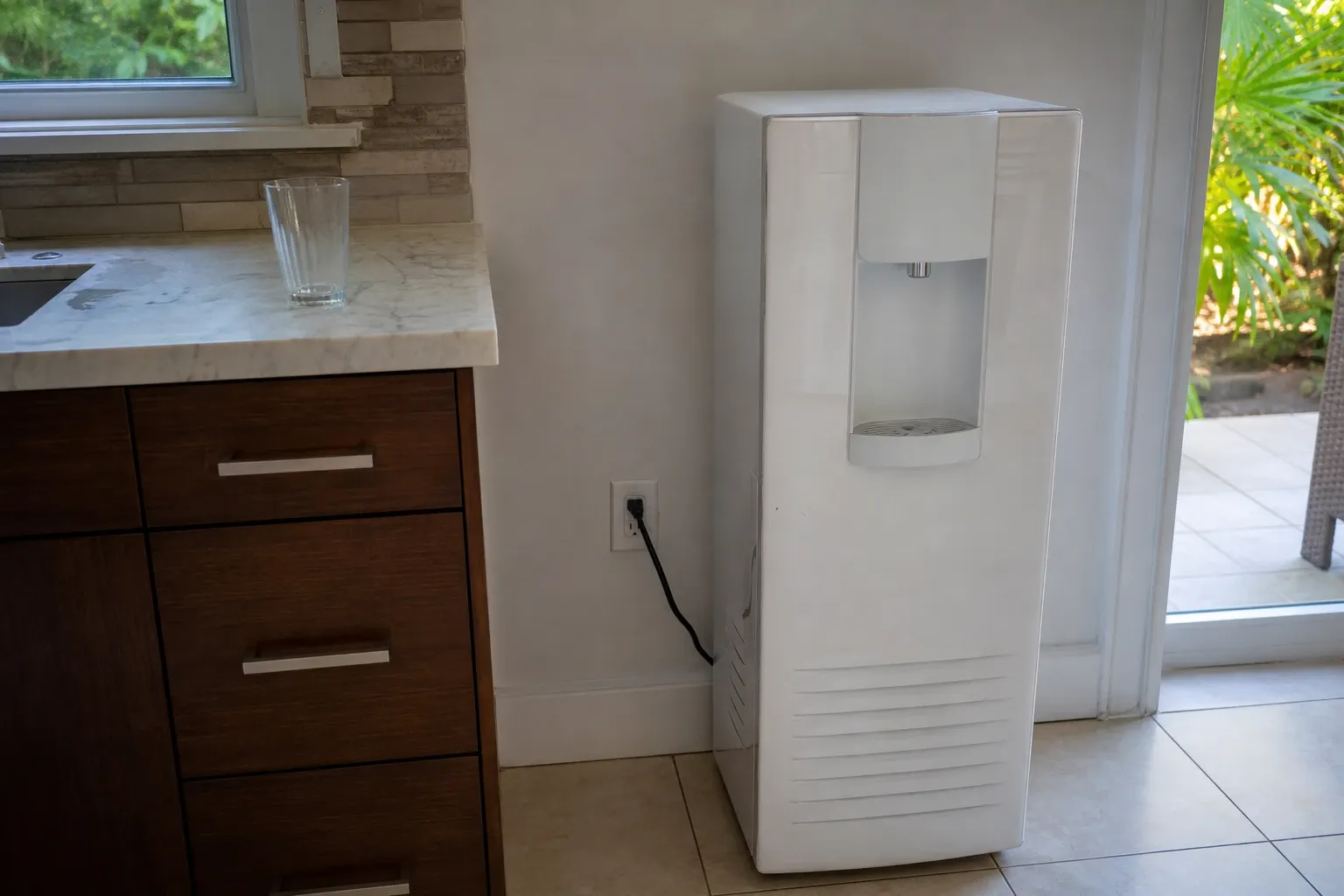
Countertop and home units sit in a kitchen or utility room and dispense water like an office cooler. They suit humid homes and people who want filtration built in. Check the rated humidity, watts, filter stages, noise and warranty.
Whole-home and commercial units
Whole-home and commercial AWGs are big machines for buildings, farms or towns. Their rated output is measured in ideal conditions, not what you should expect at home. These need pro install and a dedicated power circuit; hire a licensed electrician.
Where to buy and what to check
Buy AWGs from the maker or a known retailer, and read the spec sheet closely. Some units are sold as US-made, but “designed in” isn’t “made in”; ask the seller where it’s built.
Can I build my own atmospheric water generator?
Yes, you can build a basic atmospheric water generator, usually by reworking a dehumidifier, but it’s a hobby project for non-drinking water.
How a dehumidifier-based build works
A dehumidifier build uses the same compressor, cold coil and collection tank already inside a dehumidifier. Builders add tubing and a clean container. Keep the work to plug-in parts; anything that opens the sealed system or touches wiring belongs to a licensed electrician or HVAC tech.
When DIY makes sense and when it does not
A DIY build suits tinkerers with humid basements or garages who enjoy the project and will lab-test the water before drinking it. Skip it if your air is dry, if noise bothers you, or if you want drinking water. A dehumidifier still draws real power.
Water Freedom System is a build-it-yourself guide based on a store-bought dehumidifier; the presentation says a home build can make up to 60 gallons a day. Read our Water Freedom System review for what it covers.
See the Water Freedom System guide on the official site60-day money-back guarantee
Where do atmospheric water generators fit in a home water plan?
An atmospheric water generator fits best as a backup or extra source, next to stored water and rain collection, not as your only supply.
Everyday use
For everyday home use, a finished AWG can replace some bottled water in a humid home, which means fewer plastic bottles and a small win for environmental protection. That only helps if the unit runs well in your climate and you keep up with filters.
Emergency and remote use
In an outage, most AWGs stop unless you have backup power. Solar power with batteries can run one at an off-grid cabin or in remote areas, but size the system to the unit’s watts. During a drought, air is often drier too, so plan around that.
How they compare with storage and rainwater
Stored water is the simplest emergency water supply. The CDC advises at least 1 gallon per person per day for 3 days, two weeks if you can, and replacing it every six months. Fill that first, add rain barrels if your area allows, then add an AWG if your humidity supports one.
Every guide on this site
Water from air
- How they work
- Methods and machines
- Building your own
- Solar-powered DIY build
- Without electricity
- AWG vs dehumidifier
- Is dehumidifier water drinkable?
Choosing a unit
- Water Freedom System review
- Best units for home
- Countertop units
- Budget options
- Solar-powered units
- Altitude Water T-12
Rainwater
- Rainwater harvesting guide
- DIY rainwater system
- Tanks and cisterns
- Rainwater filters
- Is it legal in your state?
Emergency storage
Off-grid water
Questions people ask
Does an atmospheric water generator need a lot of electricity?
Yes, compared with tap water. A compressor unit runs a fan and a cooling coil much like a dehumidifier, and it uses more power per gallon when the air is dry. Check the unit’s stated watts and energy per liter, then multiply by your power rate to see your real cost.
Can dehumidifier water be drunk?
No, not as collected. Dehumidifier coils, solder, drip pans and plastics can add metals or chemicals that boiling, bleach and household filters don’t remove. Use it for plants, cleaning or flushing. It’s only a drinking option if every wetted part is drinking-water safe, the treatment fits the contaminants present, and a certified lab test confirms it.
Can an AWG run on solar power?
It can, but it takes a real setup. A compressor unit can draw hundreds of watts for hours, so you need enough panels plus batteries for night and cloudy days. Add up the unit’s watts times run hours, then size panels and storage to cover that with room to spare.
How often do the filters need replacing?
It depends on the unit and how dusty your air is. Many makers list sediment and carbon filters on schedules of a few months to a year, and UV lamps about yearly. Follow the maker’s schedule, and replace sooner if water tastes off, flow slows or the filter looks dirty.
How noisy are atmospheric water generators?
Compressor units make about as much noise as a dehumidifier or window air conditioner, a steady hum with a fan. That can bother people in a bedroom or small apartment. Look for a stated decibel rating, and place the unit in a kitchen, utility room or garage if noise matters to you.