Some links on this page are affiliate links: we may earn a commission if you buy, and your price doesn't change. Details
Alongside stored water and a plan for treating it, some households add a home-built water-from-air unit as an extra source.
See the Water Freedom System guide on the official site60-day money-back guarantee
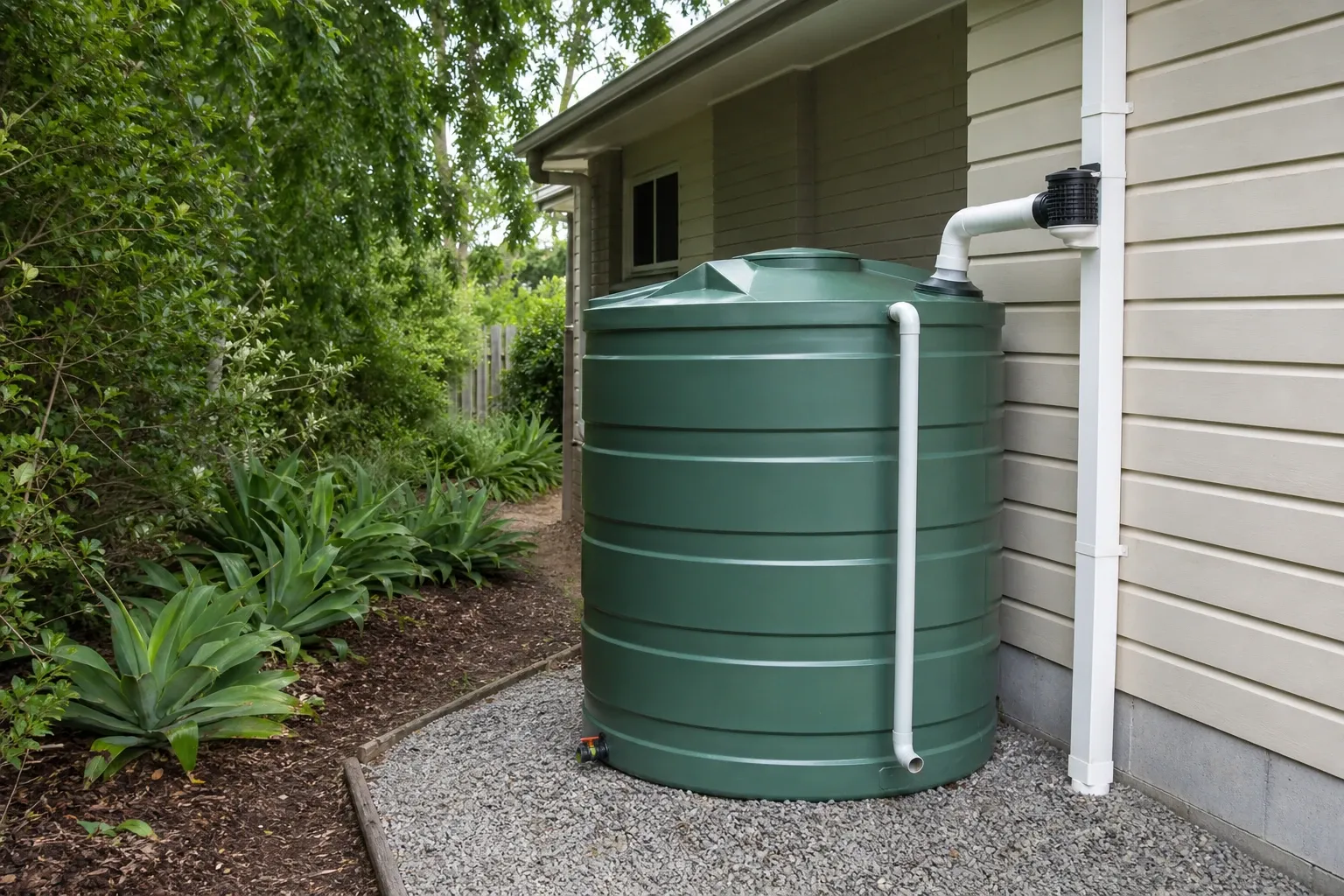
What are rainwater tanks and cisterns, and how do they fit into a harvesting system?
A rainwater tank is a storage tank that holds water from your roof until you need it. Picture the roof as a big funnel: every drop that lands on it ends up in one spot.
The tank is only one part of a rainwater harvesting system. Gutters, a screen, a filter and an overflow all protect it and keep it useful.
Tank vs cistern vs rain barrel
A rain barrel is a small container, often 40 to 80 gallons, fed by one downspout. A tank is bigger, usually hundreds or thousands of gallons. A cistern is the older word for a tank, and people often use it for large or buried ones.
The Texas Water Development Board notes that roof water was once stored on site in tanks known as cisterns.
Example: a barrel under one downspout waters a vegetable bed. A 2,500-gallon tank can carry a small homestead through a dry month.
The path of the water: roof catchment, gutters, first flush diverter, filter, tank, overflow
Water moves through a rainwater harvesting system in a fixed order. The Department of Energy lists the parts of a typical system: roof and gutters, first flush diverter, inlet filter, tank, overflow, pump and treatment.
- Roof catchment: the surface that collects rain.
- Gutters: carry it to a downspout.
- First flush diverter: sends off the dirty first burst of rain.
- Inlet filter: catches leaves and grit before the tank.
- Tank: stores the water, ideally dark and sealed.
- Overflow: lets extra water drain safely away from the base.
This setup is often enough for nonpotable use, meaning anything other than drinking, like garden irrigation, washing and toilet flushing. Potable use, meaning drinking, takes more. The same Department of Energy review says potable systems need added treatment and a licensed operator. See our guide on a filter for rainwater harvesting for options.
The roof is a kind of stormwater runoff catch point, so what washes off it, like dust and droppings, ends up in your tank.
Poly, steel, concrete or bladder: which tank type is right for my home?
Poly is the best value for most homes. Steel and concrete suit larger, long-term installs, and bladders suit tight spaces. The figures below are typical ranges that vary by region and supplier.
| Type | Typical cost (tank only) | Typical lifespan | Footprint | Best use |
|---|---|---|---|---|
| Poly | About $0.50 to $2 per gallon | 20 to 30 years | Moderate, above or below ground if rated | Most homes, gardens |
| Galvanized steel | About $1 to $3 per gallon with liner | 20 to 30 years | Wide round base | Larger homesteads |
| Concrete or ferrocement | About $2 to $5 per gallon | 30+ years | Often buried | Permanent, big systems |
| Bladder | About $0.50 to $2 per gallon | 5 to 15 years | Flat, fits crawl spaces | Tight spots, temporary |
These are rough estimates, not quotes. Get local prices before you plan a budget.
Polyethylene (poly) tanks
Poly tanks are molded plastic tanks, and they are the usual pick for most homes. They are light, easy to move and don’t rust. Choose dark or opaque ones, since light feeds algae. Skip poly if you need a very large buried tank unless it is rated for burial.
Galvanized and corrugated steel tanks
Galvanized steel tanks are corrugated panels, usually with a liner inside. They hold thousands of gallons and can be built on site. Look for a liner made for drinking water if you plan to treat it for drinking. They need a level base and can be loud in rain.
Concrete and ferrocement cisterns
Concrete and ferrocement cisterns are poured or built in place, often underground. They last decades and stay cool, which helps against algae. They cost more, take longer to build and can crack if the ground shifts. They suit people who want one permanent setup.
Bladder tanks
Bladder tanks are heavy-duty fabric bags that lie flat. They fit under decks or in crawl spaces. They are the most exposed to punctures and freezing. They suit renters, short-term needs and awkward lots.
Quick tip: If you may drink the water after treatment, look for NSF/ANSI 61 on the tank, liner and fittings. That mark means the part is certified for contact with drinking water.
How big should my rainwater tank be? A step-by-step tank sizing walkthrough
Good tank sizing starts with your longest dry spell. Your tank has to hold enough to cover your daily demand through that stretch. Your roof’s yearly supply only tells you whether the roof can refill it. Then you round to a tank size that is sold.
Step 1: Work out how much your roof can collect
A roof collects about 0.62 gallons per square foot for each inch of rain, before losses. The formula is roof area (sq ft) x rainfall (inches) x 0.623 x collection efficiency.
The Department of Energy says typical collection efficiency is 0.75 to 0.9. Rough roofs, first flush losses, evaporation and gutter spills lower it.
Step 2: Estimate your demand
Your demand is how many gallons you use per day for the job you chose. The worked example below uses a household that uses about 60 gallons of water a day, a round figure for illustration. Your own number depends on your home, your garden and the weather. Livestock needs vary by animal, so check with your local extension office.
Step 3: Cover your longest dry spell
Multiply daily demand by the number of days in your longest dry spell. The Department of Energy notes that areas with less frequent rain may need bigger tanks, and that bigger tanks raise equipment cost. Then check that your roof’s collection over the wet season can refill that volume.
Worked example
This is an illustration, not a forecast for your home. Say a household uses about 60 gallons of water a day. It has a 1,500 sq ft roof, 40 inches of rain a year and 0.8 efficiency, and its longest dry spell is 30 days.
- Storage needed: 60 x 30 = 1,800 gallons to cover the dry spell.
- Roof supply: 1,500 x 40 x 0.623 x 0.8 = about 29,900 gallons a year. That is enough to refill the tank, but the yearly total does not prove the tank will last through a dry spell. The tank size does that.
- Pick: round 1,800 gallons up to a 2,000-gallon tank.
A household using 60 gallons a day would get about 33 days from 2,000 gallons of stored water, with no refill. Your own use will set the real number.
How fast does a 50-gallon rain barrel fill, and when is a barrel not enough?
A 50-gallon rain barrel can fill in minutes during one moderate storm. One inch of rain on 1,000 sq ft of roof gives roughly 600 gallons before losses.
A single downspout often drains only part of the roof. Say it takes a quarter of that 1,000 sq ft roof. One inch of rain still sends about 150 gallons to that downspout, three times the barrel’s size.
So most barrels overflow quickly. You can link barrels together at the base with a connector, or move up to a tank. Always route the overflow away from your foundation.
Stored water stays in better shape when the container is dark, sealed and covered. Light grows algae, and open tops invite mosquitoes and debris. Use barrel water for plants, cleaning and similar jobs. Drinking it takes proper treatment first.
A barrel suits a small garden or a renter. A barrel is not enough for a livestock water supply or for long dry spells.
What does a tank installation really cost?
An installed system costs well above the tank price, since you also pay for a pad, pump, filters and plumbing. The ranges below are typical and vary by region.
| Setup | Rough installed cost |
|---|---|
| Rain barrel with diverter | $50 to $300 |
| 500 to 1,000 gallon poly tank, garden use | $1,000 to $3,500 |
| 2,500+ gallon tank with pump and filters | $4,000 to $10,000 |
| Large buried cistern, treated for indoor use | $10,000 and up |
Check for a rebate with your city, county or water utility. Texas, for example, exempts rainwater equipment from state sales tax.
For a simple payback, divide installed cost by yearly water value. The Department of Energy says higher water rates make projects more worthwhile. Many homeowners find payback is slow where water is cheap.
Ask your insurer whether a tank changes your policy. Ask your county assessor whether it affects property tax. Both vary by place. For a build plan, see our DIY rainwater harvesting system page.
Is it legal to collect rainwater where I live?
Collecting rainwater is allowed in most US states, but some set limits or permit rules. Check your state and local rules before you build.
Rules differ on how much you can store, what you can use it for and whether you need a permit for indoor use. Texas actively encourages it, and the Texas A&M extension site says the state environmental agency does not set treatment rules for a single household’s drinking water.
The Department of Energy offers a mapping tool of state rules for rainwater harvesting. Rules change, so confirm current law with your state or county.
Building and plumbing codes may apply when you plumb rainwater indoors, such as for toilets. Ask your local building office, and use a licensed plumber or electrician for pump wiring beyond a plug-in part. Our page on whether rainwater harvesting is illegal goes state by state.
What are the downsides, and how do I maintain a tank?
The main downsides are upfront cost, space, uneven rainfall, upkeep and the need for treatment before drinking. A tank works best when you plan for these early.
Maintenance is a few simple jobs:
- Clean gutters and screens each season.
- Empty the first flush diverter after storms.
- Check the overflow is clear.
- Look for sediment and clean the tank when needed.
Mosquito prevention and screens
Fine mesh screens on every opening stop mosquitoes. Cover the inlet, overflow and vent with mesh small enough to block them. Keep lids closed.
Cold-climate freeze protection
Freezing can crack pipes, pumps and shallow tanks. Bury the tank below the frost line, insulate it or drain it before winter. Bladders and shallow tanks are the most at risk.
Renters or homes without roof access
A barrel on a shed or garage downspout works for renters. Ask your landlord first. If you have no roof access, a small barrel on any downspout you can use is a start. Our rainwater harvesting hub covers more small options.
If you also want water from air, the atmospheric water generator page explains that route. It works differently, and it needs humid air. Water collected from a dehumidifier or a home-built condenser is for non-drinking uses like plants, cleaning and flushing. Coils, solder, drip pans and non-food-grade plastics can add metals or chemicals that boiling, bleach and household filters do not remove. A finished drinking-water generator treats its own water, so follow the maker’s instructions and filter schedule.
Where to go next
Your tank is one part of a full rainwater harvesting system. Start with the Rainwater Harvesting System Guide for Homeowners for the big picture.
Then choose a filter on our rainwater filter comparison, or lay out your own build with the DIY rainwater harvesting system plan. Before you buy, check your state rules on the legality page.
Questions people ask
Can I drink water from a rainwater tank?
Only if every part that touches the water is drinking-water safe, the treatment fits what is actually in the water, and a certified lab test confirms it. Roof water can carry bird droppings, dust and roof materials. For example, if lead is a concern, use a filter certified to NSF/ANSI 53 for lead. Until then, use it for plants, cleaning and flushing.
Should a rainwater tank be above ground or buried?
Above ground costs less and is easy to inspect, but it can freeze and warm in sun. Buried tanks stay cooler and save space, but cost more to install and need a tank rated for burial. Choose by climate, budget and lot.
Is rainwater harvesting different from greywater reuse?
Yes. Rainwater harvesting collects runoff from your roof. Greywater is used water from sinks, showers and laundry, and it often has its own rules and treatment needs. The two use different parts and are often regulated separately.