Some links on this page are affiliate links: we may earn a commission if you buy, and your price doesn't change. Details
Water Freedom System: A $39.69 step-by-step guide (PDF and videos) to building a home water-from-air unit around a store-bought dehumidifier, plus four bonus books.
See the Water Freedom System guide on the official site60-day money-back guarantee
Can you really make water from air without electricity?
Yes, a passive method can pull water from air, but only in small amounts and only when the weather cooperates. Passive just means no pump, fan or plug.
Two different things are at work. Air always holds some invisible water vapor. Dew forms when a surface gets colder than the dew point (the temperature at which air can’t hold its water any longer). On a clear night a surface can cool itself by radiating heat upward, and droplets then form on it. It’s the same thing that happens on a cold glass of lemonade in July.
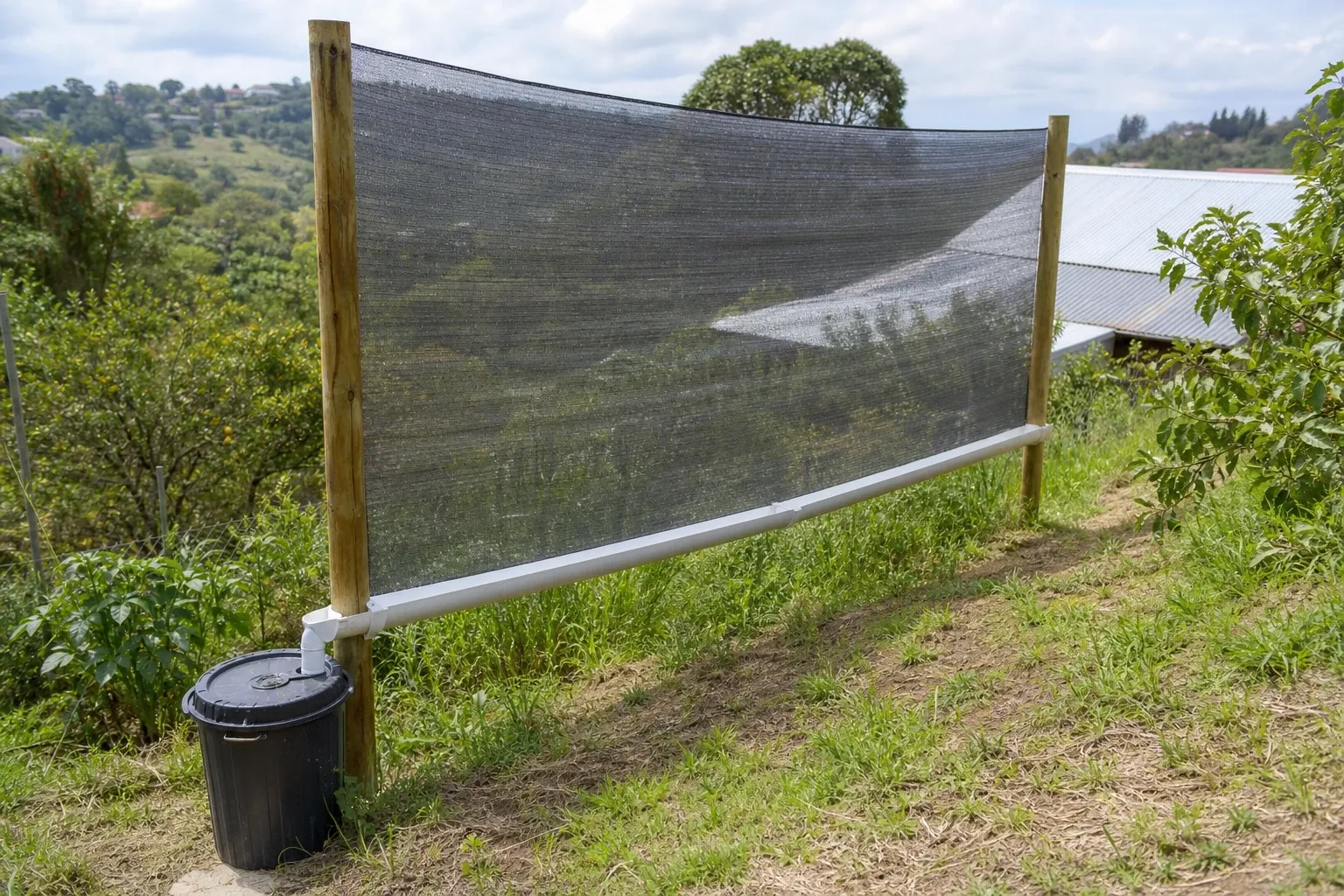
Fog is different. Fog is water that has already turned into tiny droplets in the air. A fog net doesn’t cool anything. It just catches droplets as the wind carries them through the mesh.
Relative humidity tells you how full the air is, as a percentage. The more humid the air, the more easily dew forms. In dry air the surface has to get much colder before anything appears, so output drops sharply.
So will there be water if the power is out? Sometimes, a little. Treat these methods as a supplement to stored water and rain collection, not a main supply.
Quick tip: Look up tonight’s dew point in your weather app. If the overnight low is near or below it, dew is likely.
Which passive methods work, and how much water should you expect?
Dew collectors, fog nets, solar stills and bottle condensers all work, but each suits different places and gives a small amount. Output depends on the collector area, the site and the night’s weather, so the best guide is your own measurements.
| Method | How it gets water | Needs | Best conditions | Effort |
|---|---|---|---|---|
| Dew collector | Surface cools by radiating heat at night | Tilted sheet, gutter, container | Clear, calm, humid nights with open sky | Low |
| Fog net | Mesh catches droplets already in the air | Mesh, frame, trough | Frequent real fog (coast, hills), wind-facing | Medium |
| Solar still | Sun warms damp ground, vapor condenses on plastic | Hole, bowl, clear plastic | Hot sun, damp soil | Medium |
| Bottle condenser | Chilled bottle cools nearby air | Plastic bottles, cold source | Humid air | Low |
Dew collectors
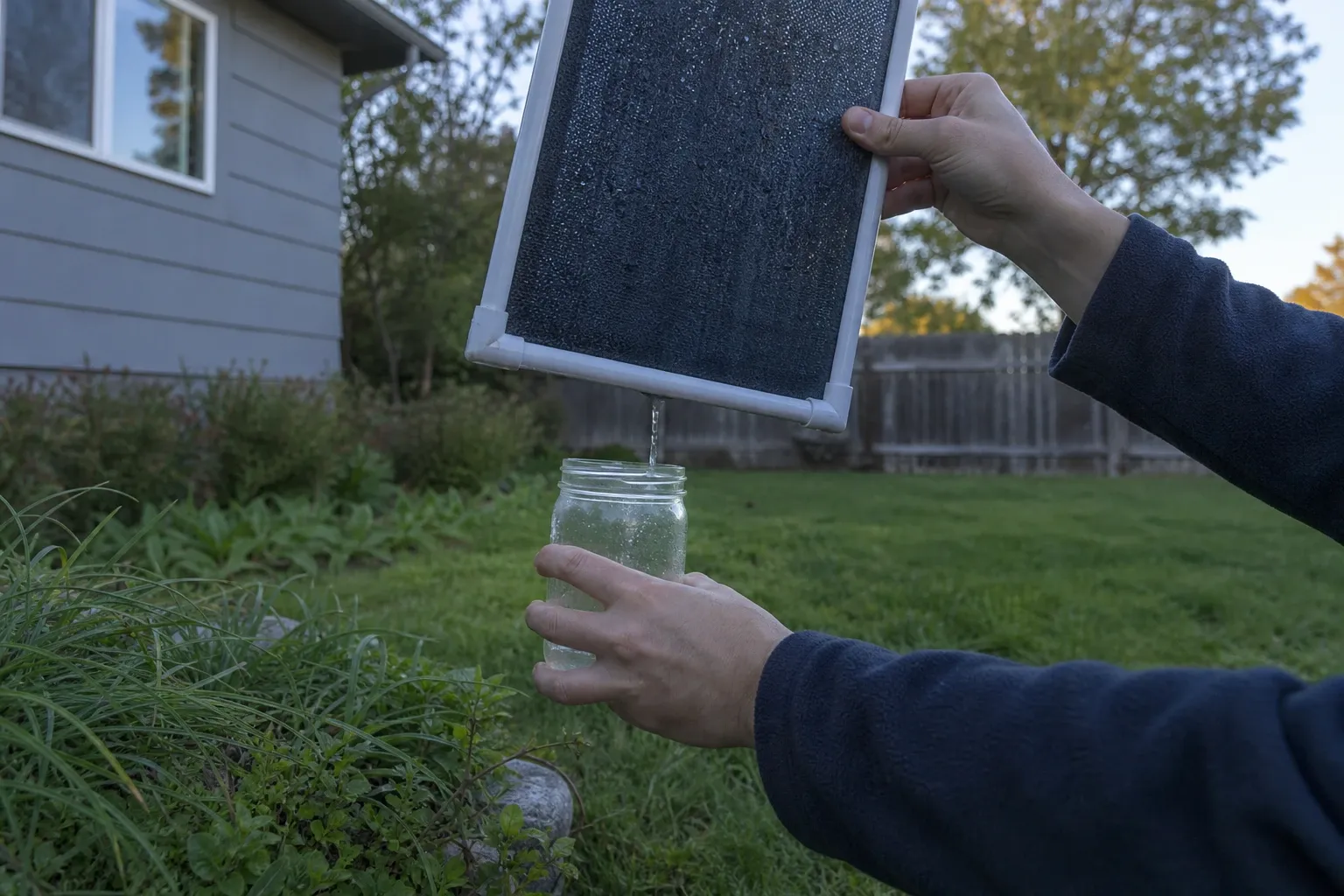
A dew collector is a tilted, food-grade sheet that cools overnight and drips into a container. It suits homes with open sky and humid, still nights. It does poorly under clouds or in wind, because clouds and wind keep the surface from cooling.
Fog nets
A fog net is a vertical mesh that catches the tiny droplets in drifting fog. It works best on a windy hillside or coastal ridge where fog rolls in often, not in a sheltered yard. It needs wind to push fog through the mesh. In a dry inland yard it will sit empty.
Solar stills
A solar still heats damp ground so the vapor condenses on clear plastic. It draws from soil moisture, not really from air, and it’s slow. It’s a known option for a stranded hiker, and less useful for daily home use.
Plastic bottle condensers
Bottle setups are mostly classroom demonstrations. A chilled bottle collects a few drops from humid air. Don’t count on them for a drinking supply.
What’s the fastest way to make distilled water at home? Boil water and catch the steam on a cool lid. That needs a heat source, but it beats every passive method for speed.
How do you build a simple dew or fog collector step by step?
Dew collectors and fog nets are built and sited differently. A dew collector is a tilted, clean, food-grade surface with open sky above it. A fog net is an upright mesh facing the wind. Both need a gutter and a covered container under them, and either takes about an hour to make.
What you need
- For dew: a food-grade sheet, such as stainless steel or food-grade plastic film
- For fog: fine mesh, ideally a food-safe plastic
- A frame of wood or pipe
- A small gutter or trough
- A clean food-grade container with a lid
- Zip ties or clips
Skip old tarps, roofing sheet and metal that may contain solder or coatings. They can shed metals and chemicals into your water.
Steps 1 to 6
- Pick the site for your type. For dew, choose an open spot with clear sky, because surfaces cool by radiating heat upward. Stay away from trees, roof edges and bird perches. For fog, choose a windy, exposed spot where fog actually drifts through.
- Build the frame. For dew, aim for about a 30 degree tilt so droplets run down instead of clinging. For fog, stand the mesh upright and face it into the wind.
- Mount the sheet or mesh. Keep it taut so water doesn’t pool in sags.
- Fit the gutter. Place it at the low edge so water runs straight into the container.
- Cover the container. A lid with a small hole keeps out dust, insects and rain splash.
- Collect at dawn. Dew evaporates once the sun hits it, so go early. Wipe the surface clean at the end of the day.
What to expect the first morning
Expect small amounts, and some mornings you’ll get nothing. Write down the collector size, the amount, the overnight low and the dew point for a week, and you’ll learn what your yard can really give.
How do you build a solar still for emergency water?
A solar still is a hole, a container and a clear plastic sheet that traps vapor from damp ground and drips it into a cup. It suits camping and emergencies, and it needs strong sun.
- Dig a hole about 3 feet wide and 18 inches deep in damp, sunny ground.
- Set a clean cup or bowl in the center.
- Cover the hole with clear plastic sheet.
- Seal the edges with soil. A leaky edge lets vapor escape, so this step matters most.
- Put a small stone in the middle of the plastic so it dips over the cup.
- Check after several hours and keep the sun on it all day.
Sunlight warms the soil, vapor rises, and it condenses on the cooler plastic. Output is small and drops in cloudy or dry weather. Never put cleaning chemicals or fuel in the soil, since those vapors can carry over.
Is water from these methods safe to drink?
Water from passive collectors isn’t safe to drink as collected, because surfaces add dust, bird droppings, microbes and plastic traces.
Treating collected water
Boiling is the simplest step for germs. The CDC says to boil water for 1 minute, or 3 minutes above 6,500 feet. The EPA also explains how to disinfect water with household bleach when you can’t boil.
For cloudy water, strain it through a clean cloth first. Boiling, bleach and ordinary filters deal with germs and particles. They don’t remove metals or chemicals, such as those from roofing, solder, fuel or containers that aren’t food-grade. If your collector or container may have added chemicals, use another safe supply and follow your local health department’s guidance. Water from a home-built condenser or dehumidifier isn’t drinking water as collected either. If you want a long-term drinking setup, use treatment certified for the specific contaminants you’re concerned about, and have the water tested by a certified lab. Repeat the testing over time, since one result isn’t ongoing proof. For more on treatment, see our guide to an off grid water purification system.
How long can it be stored
Treated water keeps best in clean, covered, food-grade containers in a cool, dark place. The CDC suggests replacing stored emergency water every six months. If it smells off or looks cloudy, don’t drink it. Switch to another safe supply.
As for the Amish, there’s no single method we can source. Common rural practice is the same: filter, then boil or disinfect.
What are the disadvantages of passive water collection?
Passive collection gives low yield, depends on weather, and needs space and attention. It’s cheap to build but poor per gallon.
- Low output. A small collector won’t cover a household. The CDC suggests at least 1 gallon per person per day for drinking and basic hygiene.
- Climate limits. Low humidity cuts dew sharply, and these simple builds won’t work reliably in dry or desert places.
- Slow and hands-on. You collect at dawn, clean often and track results.
- Poor value per gallon. A few dollars of storage containers or a rain barrel beats it.
What do powered units cost? Prices vary widely by size and brand, so check current listings. MIT has built a window-sized passive hydrogel harvester that worked in Death Valley, but it’s a research device, not something you can build in a weekend.
When is a powered atmospheric water generator a better fit?
A powered atmospheric water generator suits you when you need more than a few cups a day and have electricity from the grid, a generator or solar. It uses a dehumidifier-style cooling coil and fan to pull far more water than any passive surface.
Ready-made units are sold by retailers. Compare their output, power draw and humidity range. Our pages on water from air generators and the wider atmospheric water generator topic cover those.
If you want to build one, the Water Freedom System is a guide (PDF, videos and bonus books) for a home dehumidifier-based unit. The maker says it covers the build, a parts checklist and storage and filtration. The vendor claims up to 60 gallons a day, but the guide itself gives no output figure. Real output depends on humidity and temperature. Condensate from a dehumidifier or home build, with its coils and parts, isn’t drinking water as collected.
Pair any method with stored water and rain collection. For off-grid sites, see off grid atmospheric water generator options.
Where does this fit with other DIY water-from-air projects?
Passive collection is the lowest-effort branch of the wider DIY atmospheric water generator topic, which also covers powered builds and their limits. If you have sun but not grid power, the DIY solar atmospheric water generator planning guide is the next stop.
See what the Water Freedom System guide covers and the 60-day refund terms on the official site.
See the Water Freedom System guide on the official site60-day money-back guarantee
Questions people ask
Can I make a passive atmospheric water generator at home?
Yes, in a small way. A tilted food-grade sheet with a gutter and covered container can collect dew, and an upright mesh facing the wind can catch fog. Output is small and depends on the site and weather. Treat the water before drinking.
What is the best time to collect dew?
Collect at dawn, right after the coldest part of the night and before sunlight evaporates the droplets. Clear, calm, humid nights give the most. Wipe the surface clean afterward so dust and debris don’t build up for the next night.
Do I need to boil dew water?
Yes, treat it before drinking. Dew picks up dust, droppings and microbes from the collecting surface. Strain it, then boil for 1 minute (3 above 6,500 feet). Boiling won’t remove metals or chemicals from the surface, so use food-grade materials and another safe supply if in doubt.