Some links on this page are affiliate links: we may earn a commission if you buy, and your price doesn't change. Details
Quick picks
For hands-on budget buyers, Water Freedom System is our pick for learning a dehumidifier-based build. Compare complete costs, though, not entry fees.
Our top pick for DIY learners: Water Freedom System. It’s a build-it-yourself guide, not a machine.
- The guide costs $39.69 for the digital version (PDF and videos) with 4 bonus books, paid once. Parts, tools and power are extra.
- The maker describes a step-by-step build, with a 22-page parts and tools checklist and a 188-page printable version with photos.
- It comes with a 60-day money-back guarantee. Read the complete refund conditions in the Price and guarantee section before buying.
See the guide’s contents on the official site, and read the complete refund policy below.
See the Water Freedom System guide on the official site60-day money-back guarantee
- Innovaqua NUBE SS30: best ready-made plug-in unit for buyers in humid homes who’d rather not build anything. It costs from $2,150.
- Plastic bottle method: a science demo only. Don’t count on it as a water supply.
| Option | What you get | What it needs | Up-front cost | Refund or warranty |
|---|---|---|---|---|
| Water Freedom System | Digital guide (PDF and videos) with 4 bonus books. An optional printed book is also sold | Parts bought separately, electricity, suitable air | $39.69 digital. Printed book plus digital: $39.69 plus $9.95 shipping (US only) | 60-day guarantee. Full conditions in Price and guarantee below |
| Innovaqua NUBE SS30 | One countertop unit, 110V or 220V. The maker claims 8 gallons a day | Wall power and suitable air | From $2,150. Filters and spare parts from $25. 10-year warranty extension $380 | Returns within 30 days of delivery. Full conditions in the NUBE section below |
Water Freedom System at a glance
Water Freedom System is a step-by-step guide to building your own dehumidifier-based atmospheric water generator. It suits hands-on readers who want to learn the build themselves.
What you get
The guide comes as a PDF and videos, with an optional printed book and four bonus books. The maker lists these parts:
- The Essential Guide (114 pages)
- A Printable Version with the step-by-step build and photos (188 pages)
- A Parts and Tools Checklist (22 pages)
- A Companion Manual on minerals and remineralising (37 pages)
- An Off-Grid Guide to home power options (107 pages)
- Bonus books on Emergency Drinking Water, Water Filtration and Purification, Water Management and Water Storage
The presentation says a home build can make “up to 60 gallons a day” and that the technology is used by the military in several countries. Those are the maker’s words. We haven’t seen independent output tests for builds made from this guide, so your own output is the number that counts.
Pros
- The $39.69 guide costs less up front than the listed appliance, but parts are extra
- The maker describes a step-by-step build guide
- Bonus books cover emergency drinking water, filtration and purification, water management and water storage, the maker says
- 60-day money-back guarantee (full conditions below)
Cons
- Parts, tools and power cost extra
- Output depends on humidity and temperature
- Water from a home build isn’t drinking water as collected
- Check which seller and refund policy apply before you buy
Price and guarantee
The digital guide is $39.69, paid once. The printed book plus digital version is also $39.69, plus $9.95 shipping and handling, US only. The maker offers a 60-day money-back guarantee through ClickBank, counted from the purchase date in your confirmation email. To ask, email richard@waterfreedomsystem.com with your full name and order number, and use the subject line “Refund Request.” Shipping isn’t refunded, and digital access may be removed after a refund. Printed-book buyers can keep the book and get the product price back, or contact the maker first to return it for a full refund.
Who should skip it
- Anyone who wants a plug-in unit with no building
- People in dry or cold air: ask for output data for those conditions before buying parts
- Anyone hoping for water without power: the build needs electricity
- Anyone who wants drinking water without drinking-water-safe parts and a certified lab test
See the guide’s contents on the official site and read the refund policy above.
See the Water Freedom System guide on the official site60-day money-back guarantee
Innovaqua NUBE SS30
The NUBE SS30 is a ready-made countertop atmospheric water generator. The maker claims 8 gallons a day but doesn’t say under what conditions. Your output will depend on your home’s humidity and temperature.
Pros
- Plug-in simplicity, sold in 110V or 220V
- Filters and spare parts sold by the maker, from $25
- Optional warranty extension to 10 years for $380
Cons
- High up-front price
- Strict returns. Contact info@innovaqua.org within 30 days of delivery. Standard returns cover transit damage or defects. Other returns need the unit unused, in original condition and packaging, with proof of purchase. Otherwise the buyer pays return shipping and import taxes to Mexico. Return shipping isn’t refunded, sale items can’t be refunded, and returns after 30 days get partial refunds only.
Which cheap atmospheric water generator is the best buy for my budget?
The best budget buy is the option with the lowest true cost for your air and your skills, not the lowest sticker price. Judge each option on five things: up-front price, cost per liter, electricity use, upkeep and how much humidity it needs.
Low-cost ready-made units
Ready-made units suit buyers who want to plug in and walk away, and who will pay for it. The NUBE SS30 starts at $2,150. Before you buy, check the capacity (liters) rating and what conditions the maker tested it in.
DIY dehumidifier builds
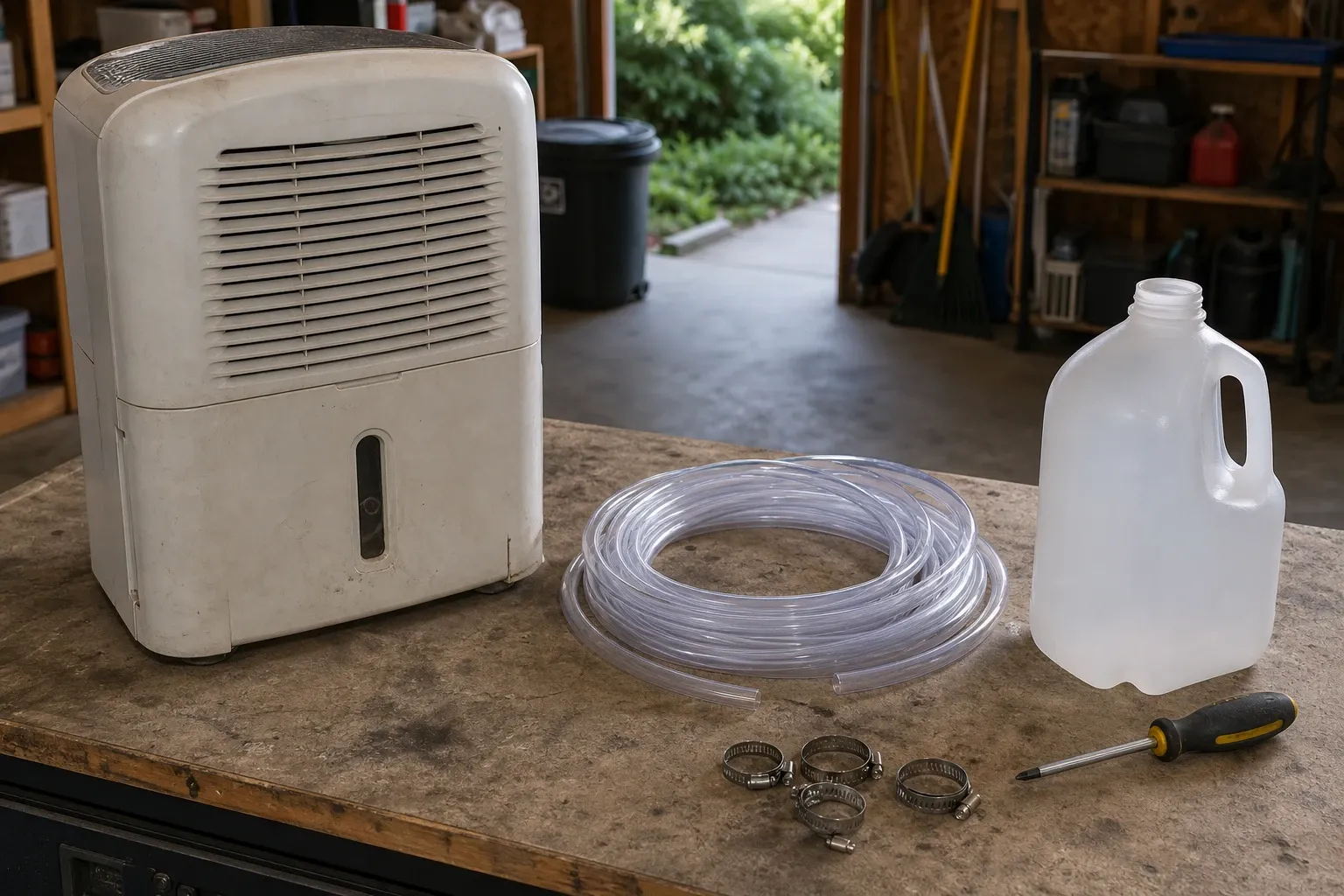
A dehumidifier-based build is one DIY approach, and its total cost and usable output vary with your parts and air. It suits tinkerers who’d rather learn the system than buy a sealed box. Keep in mind that adding food-grade collection parts doesn’t make a household dehumidifier a drinking-water machine.
Plastic bottle and fog-net gimmicks
Bottle tricks and small fog nets make fun demos. There’s no good evidence they can supply a household.
Is atmospheric water generation real, and how does it work?
Yes, atmospheric water generation is real physics. How much you get is limited by relative humidity (how full of water the air is, as a percentage) and ambient temperature (the temperature of the air around the unit).
Condensation: compressor, refrigerant and dew point
A condensing unit collects moisture by cooling a surface below the air’s dew point, like the drops that form on a cold glass of iced tea. The dew point is the temperature where air starts to drop its water. A compressor pumps refrigerant through coils to chill them. Droplets form on the coils and drip into a tank.
How much water you get, and how much power that takes, changes with your conditions. Measure it where the unit will actually run.
How much does a water from air machine cost, and what does a liter cost?
The NUBE SS30 starts at $2,150, and its filters and spare parts are listed from $25. A DIY build starts with a $39.69 guide plus parts. The cost of each liter depends heavily on your air.
Upfront price tiers
- DIY guide plus parts: $39.69 for the Water Freedom System guide, plus parts you price yourself
- Ready-made countertop unit: the NUBE SS30 starts at $2,150
Electricity per liter
You can work out electricity use per liter at home. Plug the unit into a plug-in energy meter for a day. Divide the kilowatt-hours used by the liters collected, then multiply by your power rate from your bill. Do this on a humid day and on a dry day, because the number can change a lot.
Worked example: cost per gallon
This is an example with made-up inputs, to show the maths. Swap in your own metered numbers. Both assume an example electricity rate of $0.15 per kilowatt-hour over one year; use your own rate.
Example A: DIY build (before lab testing)
- Guide $39.69 plus about $270 in parts = $309.69
- Power: an example 300 W running 12 hours a day = 300 / 1,000 x 12 = 3.6 kWh a day, x $0.15 = $0.54 a day, about $197 a year
- Year total: about $507
- If it collects an example 2 gallons a day (730 gallons a year): about $0.69 per gallon
Example B: NUBE SS30
- Unit $2,150, plus an example two filters at $25 = $50
- Power: an example 500 W running 24 hours a day = 500 / 1,000 x 24 = 12 kWh a day, x $0.15 = $1.80 a day, about $657 a year
- Year total: about $2,857
- At the maker’s claimed 8 gallons a day (2,920 gallons a year): about $0.98 per gallon
If real output is half the example figure, the cost per gallon roughly doubles. Spreading the purchase price over more years lowers it. And the DIY water in Example A is for plants, cleaning and flushing, so compare it with tap water, not bottled.
Filters and maintenance
Filters and cleaning are part of the real price. NUBE SS30 filters and spare parts start at $25. Keep any collection equipment clean, and pick any treatment system based on the contaminants actually present, not on the idea that a filter cartridge makes water drinkable.
Is it cheaper than bottled water?
Compare total purchase, electricity, upkeep and treatment costs per usable liter with the bottled water you’d otherwise buy. Use this cost-per-liter worksheet:
- Purchase price divided by the months you expect to use it
- Plus monthly power cost
- Plus monthly filter cost
- Divide the total by liters collected per month
Measure usable output and power use under the conditions where the unit will run. Compare the result with what you pay per liter for bottled water now.
Can I build a cheap DIY atmospheric water generator?
Water Freedom System gives instructions for a dehumidifier-based build, but its total cost and usable output depend on your parts and your air. For more build options, see our DIY atmospheric water generator guide.
Plastic bottle method: what it can and cannot do
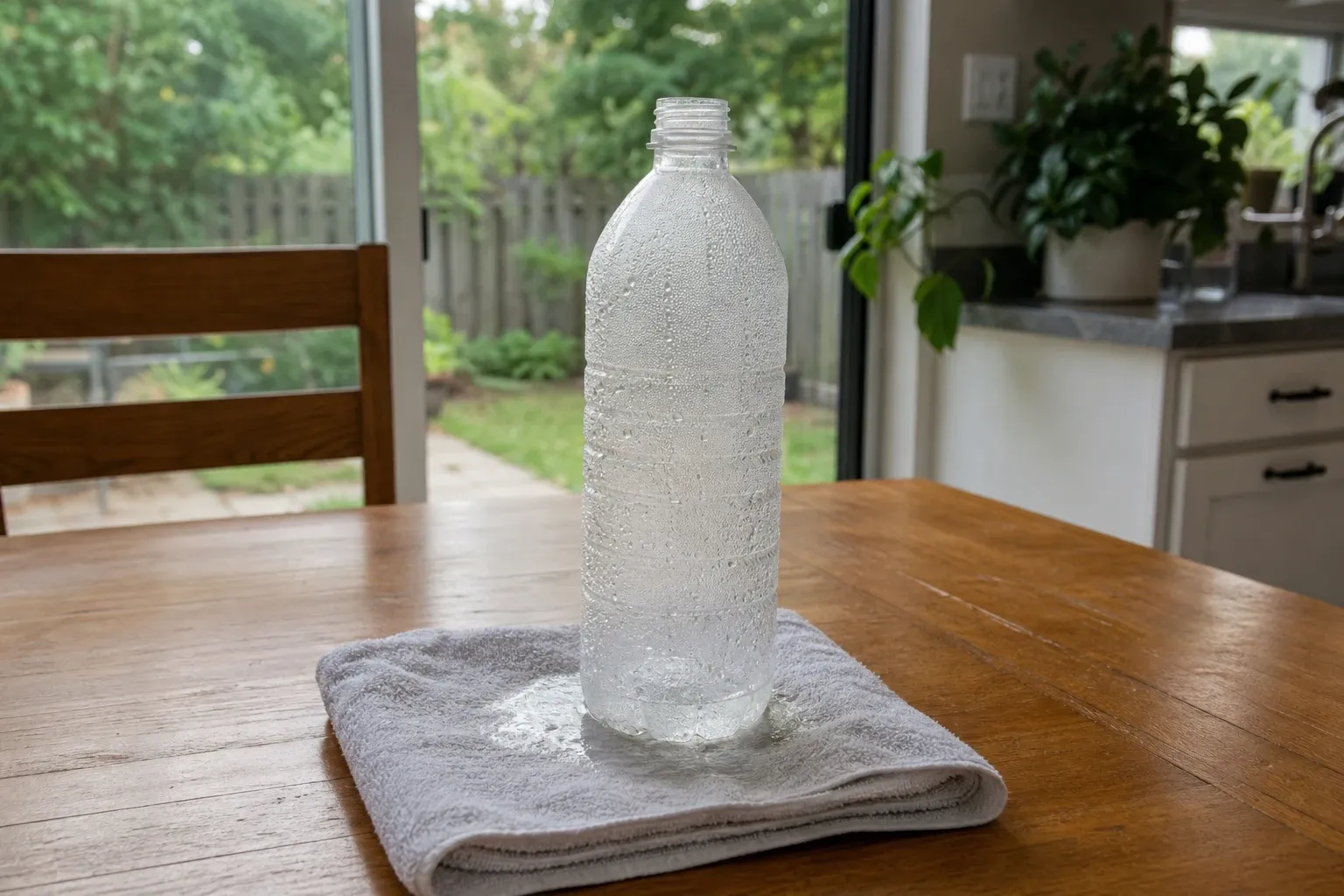
A bottle can show how moisture forms on a surface cooled below the dew point, which makes it a good lesson for kids. Drops can form if the bottle’s surface gets colder than the surrounding air’s dew point. Don’t count on it as an emergency drinking-water supply.
Dehumidifier-based build
A dehumidifier-based build is a DIY option, with parts and running costs on top of any guide price. When you judge a build plan, look for clear instructions and output figures under stated conditions. The hidden costs add up: parts bought separately, food-grade tubing and tanks, electricity and your time. If you’re curious how the machines differ, our page on atmospheric water generator vs dehumidifier explains it. Stick to plug-in parts, and call a licensed electrician for any wiring work.
How do I make the collected water safe to drink?
Dehumidifier and home-build water isn’t drinking water as collected. Use it for plants, cleaning and toilet flushing.
Boiling, bleach and household filters can kill germs or catch particles. They don’t remove metals or chemicals that coils, solder, drip pans or non-food-grade plastics can add. A household dehumidifier isn’t built for drinking water.
Only think about drinking home-build water if all three of these are true:
- Every part the water touches is drinking-water safe.
- The treatment fits the contaminants actually present, for example a filter certified to NSF/ANSI 53 for lead.
- A certified lab test confirms the water is safe.
Finished drinking-water generators like the NUBE SS30 treat their own water. Follow the maker’s instructions and filter schedule.
Quick tip: Clean the collection tank and tubing on a schedule, not just when they look dirty.
Cheap options compared: unit or DIY?
The right option depends on how humid your home is and how handy you are. This table sets out both with their hidden costs.
| Tier | Up-front cost | Running cost | Output depends on | Upkeep | Best for | Main drawback |
|---|---|---|---|---|---|---|
| DIY build (Water Freedom System) | $39.69 guide, plus parts | Power | Humidity and temperature | Cleaning | Handy readers who want to learn the build | Water is for non-drinking uses as collected |
| Ready-made unit (NUBE SS30) | From $2,150 | Power, filters from $25 | Humidity and temperature | Filter swaps | Plug-in simplicity | High price, strict returns |
The decision rule is simple:
- If you have a humid home and want drinking water with plug-in ease, buy a finished unit.
- If you’re handy and want water for plants, cleaning or flushing, try a DIY build.
- If you’re just curious, try a bottle demo.
Water Freedom System suits budget readers who want to build. The $39.69 guide costs less up front than the listed appliance, but parts are extra; see the complete refund policy above. Buyers who’d never pick up a tool may prefer the NUBE SS30.
Start with the guide and decide on parts once you know what your build needs.
See the Water Freedom System guide on the official site60-day money-back guarantee
Where cheap options fit among home water-from-air choices
Cheap options are one slice of a wider choice about making water from air at home. If you’d like to see higher-priced machines judged side by side, our best atmospheric water generator picks for home use cover them. Short on space? Our countertop atmospheric water generator comparison looks at small units. For the basics on how these machines work, start with our atmospheric water generator hub.
Whatever you choose, keep some stored drinking water on hand. That matters more than any single machine.
Questions people ask
Do cheap atmospheric water generators work in dry climates?
Condensing units depend on your air conditions. Ask for model-specific output figures for the temperatures and humidity where you’ll use it, and check your local relative humidity before spending money on any option.
How often do filters need replacing?
Follow the maker’s replacement schedule for your unit or cartridge. If the water tastes unusual or the unit starts acting differently, stop drinking it and find the cause, rather than assuming a new filter fixes it. Budget for replacements as part of your yearly running cost.
What should I check on my electricity bill before buying?
Find your price per kilowatt-hour on your bill. Divide the unit’s watts by 1,000, multiply by the hours it runs each day, then multiply by your rate. For example, 300 W for 12 hours at $0.15 is 300 / 1,000 x 12 x $0.15 = $0.54 a day. Divide that by liters collected. Units cycle on and off, so a plug-in meter reading in kilowatt-hours is more accurate.