Some links on this page are affiliate links: we may earn a commission if you buy, and your price doesn't change. Details
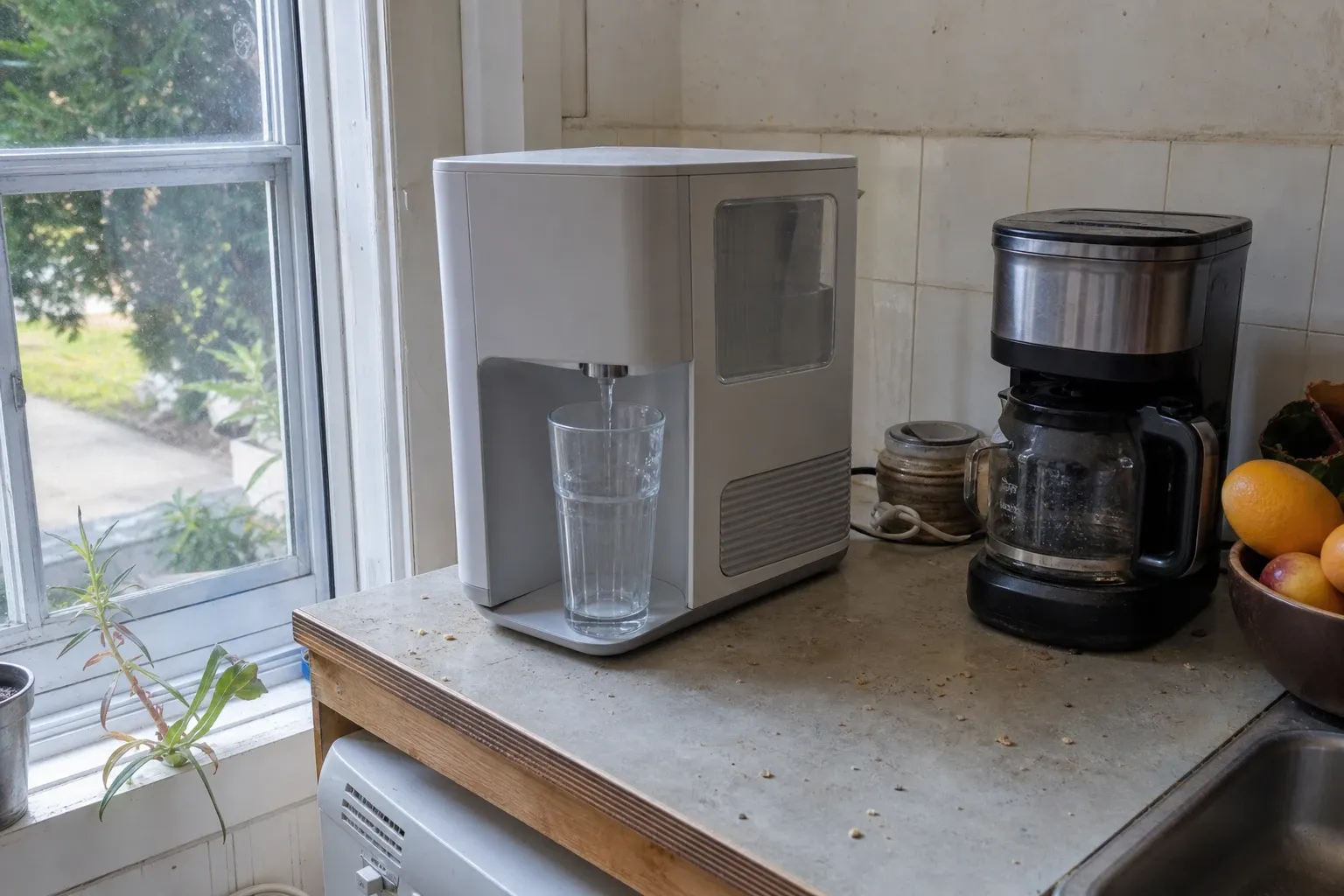
Quick picks
For most people who want water from air on a counter, a finished machine is the honest first choice. It treats its own water, comes with a warranty and needs no building.
Our top pick: Innovaqua NUBE SS30
- A ready-made countertop option with a published starting price of $2,150.
- The maker rates it at 8 gallons (about 30.3 L) a day.
- Filters and spare parts start at $25, and 110V and 220V versions are sold.
The others, and what each does best:
- Watergen GENNY (GENNY+): best for a home or office that wants an output rating tied to stated conditions. Watergen rates it at up to 20 L (5.28 gal) a day at 26.7 °C and 60% relative humidity. Price is by quote only.
- Altitude Water Trident T-12: best for buyers who want the highest listed output rating and a 7-gallon tank, at $4,299.99. The maker rates it at up to 15 gallons a day, depending on temperature and humidity.
- Water Freedom System: a separate build-it-yourself option, not a machine. The guide costs $39.69, parts run about $270, and you pay for the power it uses.
See the Water Freedom System guide on the official site60-day money-back guarantee
Which countertop water-from-air option fits which buyer?
Your climate matters more than the brand. The same machine can give very different amounts of water on a muggy Gulf Coast summer day and a dry Arizona winter one.
Buy a ready-made countertop unit if
- You live where indoor or outdoor air is often humid and warm.
- You want drinking water and would rather pay more than spend weekends building.
- You want treatment built in and a warranty to lean on.
Build your own if
A DIY build suits people who want hands-on work and want to learn how water-from-air works from the inside.
- You are willing to buy parts separately and price the complete build before deciding.
- You like fixing and tuning things yourself.
- You mainly want water for plants, cleaning or flushing.
Anything past plug-in parts is a job for a licensed electrician.
Skip both if
- Your air is usually dry, or your home stays cool most of the year.
- You need a set daily volume for drinking and cooking.
- You don’t want to pay for a device’s electricity use.
Stored water in clean containers is a solid choice on its own.
Do atmospheric water generators actually work?
Yes. An atmospheric water generator cools air until it drops its water, then collects that water. It’s the same physics as a cold drink sweating on a summer day.
These condensing units collect moisture by cooling air until droplets form, which then drip into a reservoir (the storage tank). You can read the full step-by-step on our page about how atmospheric water generators work.
The dew point in plain words
The dew point is the temperature at which air can’t hold its water any longer and starts to drop it as droplets (condensation). A unit has to chill air below that point to make water. When the dew point is close to room temperature, the unit collects water easily. When it’s far below, the machine works hard and collects little.
Quick tip: Check whether your weather station or weather app gives a dew-point reading, and compare your conditions with the temperature and humidity behind a model’s output rating.
Why humidity and temperature set the output
Relative humidity is how full the air is of water compared with the most it could hold at that temperature. Warm, damp air gives the most water; cool, dry air gives the least.
That’s why makers tie ratings to conditions. Watergen says GENNY+ output falls in cooler, drier air. Altitude Water recommends at least 40% relative humidity for the T-12. Treat ratings as figures that depend on conditions, not daily output you can count on. Innovaqua doesn’t give the conditions behind the SS30’s rating.
Countertop and small units compared
Small atmospheric water generators differ most in price, rated output and refund terms. The table uses each maker’s own figures.
| Option | What you get | Rated daily output (maker’s figure) | Up-front cost | Refund or warranty |
|---|---|---|---|---|
| Innovaqua NUBE SS30 | One countertop unit, 110V or 220V | 8 gal (about 30.3 L) | From $2,150 | Returns within 30 days: damaged or defective units qualify; other returns must be unused, in original condition and packaging, with proof of purchase. Buyer pays return shipping and Mexico import taxes unless damaged in transit or defective; return shipping isn’t refunded, sale items are excluded, and later returns get partial refunds only. Contact info@innovaqua.org |
| Watergen GENNY+ | Home and office unit, plug-in, no plumbing, 11 L tank | Up to 5.28 gal (20 L) at 26.7 °C and 60% RH | Quote from Watergen or a dealer | Limited materials-and-workmanship warranty: 12 months from installation; filters and UV lamps 3 months. Contact Watergen or the selling dealer |
| Altitude Water Trident T-12 | One T12 120V 60Hz Heavy Duty unit, 7 gal tank, about 750 W | Up to 15 gal (about 56.8 L), depending on temperature and humidity | $4,299.99 | A 1-year full warranty is advertised, but the terms disclaim warranties and sell products “as is”. Returns must be in original condition; customer pays return shipping unless defective. Contact info@altdwater.com or 1-954-530-5753 |
| Water Freedom System | Digital guide (PDF and videos) with 4 bonus books; optional printed book | Depends on your build | $39.69 guide, plus about $270 in parts and ongoing power (printed book adds $9.95 shipping, US only) | 60 days from the emailed purchase date through ClickBank; shipping isn’t refundable and digital access may be removed. Printed-book buyers may keep the book for a product-price refund or contact the seller before returning it. Email richard@waterfreedomsystem.com with full name, order number, subject “Refund Request” and your book choice, if any |
Gallons come first, with liters in brackets (1 gallon = 3.785 liters). Every output and power figure is the maker’s rating, not an independent test.
Size, placement and noise
Confirm each model’s dimensions, support needs and vent clearances with the seller before choosing a spot. Keep it away from cooking steam and grease, and leave easy access to the reservoir. Warm exhaust will add a little heat to the room.
These makers don’t give noise measurements for the models here. Ask the seller for a measured noise rating or a demonstration before putting one near where you sleep or take calls.
Filter upkeep
Innovaqua sells SS30 filters and spare parts from $25. Watergen’s warranty covers filters and UV lamps for only 3 months, which hints they’re wear parts. Ask any seller for the replacement schedule and budget for it every year.
Innovaqua NUBE SS30
Pros
- Published starting price and filters and spare parts from $25.
- 110V and 220V versions; a 10-year warranty extension costs $380.
- Several color options.
Cons
- Strict return rules, and the buyer usually pays return shipping and Mexico import taxes.
- The rating conditions and tank setup aren’t given; confirm them with Innovaqua.
Watergen GENNY
Pros
- Clear output rating tied to temperature and humidity.
- Plug-in with no plumbing; 11 L tank; multi-stage treatment with minerals added, says the maker.
Cons
- No public US price; you’ll need a quote to buy, lease or pay per liter.
- Filters and UV lamps covered for only 3 months.
Altitude Water Trident T-12
Pros
- Highest listed output rating and largest disclosed tank among these machines.
- Ozone, dual-stage carbon block and calcite treatment, plus a MERV-13 air filter.
- The maker says it can run from grid, solar, battery or generator.
Cons
- The highest published purchase price here; GENNY+ needs a quote.
- The advertised warranty clashes with “as is” terms, so ask before buying.
What does air-made water cost to produce?
Electricity consumption is the main running cost. The formula: watts × hours run ÷ 1,000 = kWh per day. Divide by the gallons you actually collect, then multiply by your electricity rate. These makers don’t give kWh per liter, so you’ll need to measure power use and water collected yourself.
Worked example at three electricity rates
Using the maker’s rating for the T-12 (about 750 W and up to 15 gallons a day), running 24 hours uses 18 kWh. If it made the full 15 gallons, that’s 1.2 kWh per gallon (about 0.32 kWh per liter).
| Sample rate per kWh | Cost per gallon (at full rated output) | Cost per liter |
|---|---|---|
| $0.12 | about $0.14 | about $0.04 |
| $0.17 | about $0.20 | about $0.05 |
| $0.30 | about $0.36 | about $0.10 |
If drier air means you collect 5 gallons from the same 18 kWh, energy per gallon triples to 3.6 kWh, so the middle rate becomes about $0.61 a gallon. Add yearly filter spend and the unit’s price spread over its life, then compare the total with your local tap-water rate.
Is atmospheric water healthy to drink?
A finished drinking-water generator treats its own water. Follow the maker’s instructions and filter schedule, and clean the reservoir the way the maker says. Any purity claims are the makers’ own. Our guide to the atmospheric water generator covers more background.
DIY and dehumidifier water is not drinking water as collected
Water from a dehumidifier or home build needs a certified lab test before drinking; until then, use it for plants, cleaning and flushing. Boiling, bleach and household filters kill germs or catch particles, but they don’t remove metals or chemicals that coils, solder, drip pans or non-food-grade plastics can add.
Only consider drinking it if every part the water touches is drinking-water safe, the treatment fits the contaminants actually present (for example, a filter certified to NSF/ANSI 53 for lead), and a certified lab test confirms it. Your local health department can advise on testing.
Mineral content and taste
Water made from air starts out very low in minerals, so it can taste flat. That’s why GENNY+ adds minerals, and why the Water Freedom System companion manual covers remineralising, says the maker.
What are the disadvantages of an atmospheric water generator?
Consider electricity use, climate-dependent output, upkeep, missing noise data and total cost per gallon before you buy.
| Pros | Cons |
|---|---|
| GENNY+ is plug-in with no plumbing; confirm install needs for the others | Uses electricity whenever it runs |
| An extra water source at home | Output drops in dry or cool air |
| GENNY+ and the T-12 list tanks and treatment; ask Innovaqua about the SS30 | Filters and lamps to replace |
| Confirm dimensions and clearances to find a spot | Compare total cost per gallon with your tap-water rate |
Troubleshooting low output
- Check room humidity; Altitude Water recommends at least 40% relative humidity for the T-12.
- Warm the room if it’s cool.
- Clean or replace a clogged air filter.
- Wipe a dusty cooling coil, following the maker’s instructions.
- Keep vents clear of walls and clutter.
Water Freedom System: the build-it-yourself option
Water Freedom System is a step-by-step guide to building a dehumidifier-based water-from-air unit. It’s a guide, not a machine.
What is in the guide
The package includes, says the maker:
- The Essential Guide, 114 pages, and a Printable Version, 188 pages, with the build and photos.
- Parts and Tools Checklist (22 pages), Companion Manual (37 pages) and Off-Grid Guide (107 pages).
- Bonus books: Emergency Drinking Water, Water Filtration and Purification, Water Management and Water Storage.
- Videos, with an optional printed book.
The sales presentation says a build can make up to 60 gallons a day; the guide itself gives no output figure, and independent output tests of these builds aren’t available.
Whole cost and limits
- Guide: $39.69 once (printed book plus digital is also $39.69, plus $9.95 shipping, US only).
- Parts: about $270, bought separately.
- Power: ongoing, using the formula above.
- Output depends on humidity and temperature.
- The water is for non-drinking uses unless it meets the safety steps above.
Refund terms
The 60-day ClickBank refund window runs from the purchase date in your confirmation email. Shipping isn’t refundable, and digital access may be removed after a refund. Before paying, confirm your order goes through ClickBank. Email richard@waterfreedomsystem.com with your full name, order number and subject “Refund Request”; printed-book buyers should also say whether they’ll keep or return the book and contact the seller before returning it.
See the Water Freedom System guide on the official site60-day money-back guarantee
Where this fits with other water-from-air choices
If you’re open to larger models, our roundup of the best atmospheric water generator options for home use compares them side by side. Shopping on price? See our guide to the cheap atmospheric water generator picks.
Our pick for most readers
If you live somewhere humid and want drinking water, the Innovaqua NUBE SS30 is the clearest priced finished choice, from $2,150 and rated at 8 gallons a day by the maker. Want a stated test condition? Ask Watergen for a GENNY+ quote. If you’d rather build your own, Water Freedom System costs $39.69 for the guide; its parts list adds about $270 by the guide’s own figures, plus electricity, and the water should pass a certified lab test before you drink it.
See the Water Freedom System guide on the official site60-day money-back guarantee
Questions people ask
Can I run a countertop atmospheric water generator on solar power?
Some makers say yes. Altitude Water says its T-12, which draws about 750 W, can run from solar, battery or generator. That’s a lot of steady power, so you’d need a large panel and battery setup. Have a licensed electrician size and install anything beyond plug-in parts.
How often should I clean the reservoir and replace filters?
Follow the model’s reservoir-cleaning and filter instructions, and ask the maker for a schedule if none comes with it. Watergen covers filters and UV lamps for only 3 months under its warranty, a sign they need regular replacement.
Is a countertop unit enough for a household?
Usually not as the only source. Published ratings range from 5.28 to 15 gallons a day. GENNY+ is rated at 26.7 °C and 60% relative humidity, T-12 output depends on temperature and humidity, and Innovaqua doesn’t give the SS30’s rating conditions. Treat a unit as an extra source next to stored water.