Some links on this page are affiliate links: we may earn a commission if you buy, and your price doesn't change. Details
Alongside stored water and a plan for treating it, some households add a home-built water-from-air unit as an extra source.
See the Water Freedom System guide on the official site60-day money-back guarantee
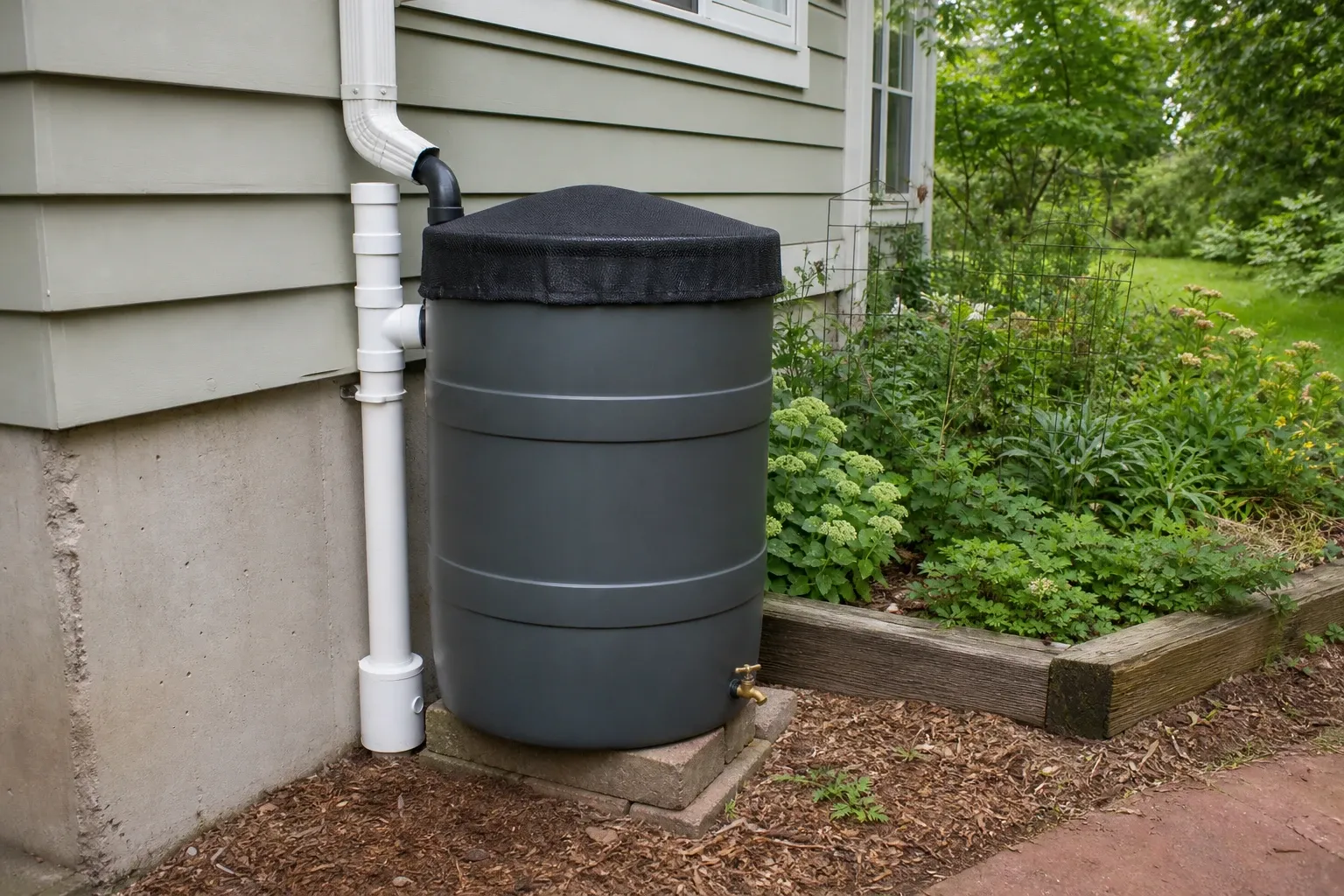
Start here
This hub covers a whole home rainwater harvesting system in the order you’ll make decisions. These guides go deeper on each step:
- Check your state’s rainwater rules: which states limit barrels, require registration or offer incentives.
- Pick and size water tanks for rainwater harvesting: barrels, poly tanks and cisterns compared by size and fit.
- Choose a filter for rainwater harvesting: screens, sediment cartridges, UV and how they stack.
- Plan a rainwater harvesting system DIY build: parts list and step-by-step setup for a barrel or small tank.
- Learn how an atmospheric water generator works: a backup idea for dry stretches when humidity is high enough.
What is rainwater harvesting, and how does a home system work?
Rainwater harvesting is collecting rain that runs off a roof, cleaning out debris, and storing it in a container to use later. The Department of Energy describes it as a way to capture, divert and store rooftop rain for uses like irrigation, washing and toilet flushing, and notes it can reach potable standards with added filtration and disinfection.
Most homeowners use it for gardens and outdoor chores. Drinking it is possible, but only with a proper treatment setup.
The five parts: catchment, conveyance, filtration, storage, delivery
Every rainwater harvesting system has the same five jobs, whatever its size:
- Catchment: the roof that catches the rain.
- Conveyance: the gutter and downspout that move it.
- Filtration: a leaf guard, screen and first flush diverter that keep debris out.
- Storage: a rain barrel, storage tank or cistern, with an overflow.
- Delivery: a spigot, hose or pump that gets water to where you use it.
A plain example: one rainstorm on one roof
One inch of rain on a 500 sq ft section of roof sends roughly 300 gallons toward a single downspout. The first few gallons carry dust, pollen and bird droppings, so the diverter dumps them. Cleaner water then fills the barrel, and once it’s full, the overflow sends the extra away from the house.
The decision order is simple: check the law, size your supply, pick a tank, add filtering, decide on treatment, then plan maintenance.
Is it legal to collect rainwater where I live?
Collecting rainwater is allowed in every US state, though a handful limit how much you can store or ask you to register. Local rules can add more conditions, so treat any table as a starting point.
Selected-state overview
| State | General status | Notes to confirm locally |
|---|---|---|
| Colorado (Colorado Division of Water Resources) | Allowed with limits | Households may use up to two rain barrels totaling 110 gallons, under conditions set by the state |
| Utah (Utah Division of Water Rights) | Allowed; registration for larger storage | Up to two covered containers of 100 gallons each without registration; up to 2,500 gallons with registration |
| Texas (Texas Commission on Environmental Quality) | Encouraged | Equipment sales tax exemption; state guidance on domestic drinking-water systems |
| Nevada (Nevada Division of Water Resources) | Allowed for qualifying homes | Qualifying residential rooftop collection is allowed |
| Washington (Washington State Department of Ecology) | Allowed, some areas limited | Rules can depend on the water basin |
| Oregon, California, Arizona (state water agencies) | Allowed | Some cities offer rebates for barrels or tanks |
| Most other states | Allowed | Few or no state limits; local codes still apply |
Rules change. Confirm with your state water agency, county and city before you buy a large tank.
Checks beyond state law: permits, HOA rules, code for indoor plumbing
State law is only the first check. Homeowners associations can limit where tanks sit or how they look. The DOE notes permits may be required, and they often apply to large cisterns, buried tanks or anything plumbed indoors.
Indoor use usually brings plumbing code into play, including backflow prevention so rainwater never flows back into city lines. Use a licensed plumber for that work, and a licensed electrician for any pump wiring beyond plug-in parts.
How much water can my roof actually collect?
A roof yields about 0.62 gallons of water per square foot for each inch of rain, before losses. That number does most of the sizing work for you.
The sizing formula: roof area x rainfall x 0.623 x efficiency
The DOE uses this same approach in its sizing method for storage tanks, with a collection efficiency of about 0.75 to 0.9. Efficiency covers losses from rough roofing, the first flush, evaporation, gutter spills and leaks.
Gallons = roof area (sq ft) x rainfall (inches) x 0.623 x efficiency
Measure roof area as the footprint from above, not the sloped surface. Roof pitch still matters a little: the DOE notes lower-pitched, smoother roofs tend to shed and catch more water than steep, textured ones.
A worked example for a 1,500 sq ft roof
Say your home’s footprint is 1,500 sq ft and you use 0.8 efficiency:
| Rainfall | Math | About how much you collect |
|---|---|---|
| One 1-inch storm | 1,500 x 1 x 0.623 x 0.8 | 748 gallons (2,830 liters) |
| A 3-inch month | 1,500 x 3 x 0.623 x 0.8 | 2,240 gallons |
| A dry-climate year, 12 inches | 1,500 x 12 x 0.623 x 0.8 | 9,000 gallons |
| A wetter year, 30 inches | 1,500 x 30 x 0.623 x 0.8 | 22,400 gallons |
Run the same math with your local monthly rainfall, not just the yearly total.
Matching demand to supply
Your dry spells decide your storage capacity, not your wettest month. If your garden needs 150 gallons a week and summer brings six dry weeks, you need about 900 gallons stored to bridge the gap. Areas with rare storms need bigger tanks, which raises cost.
What size tank or barrel do I need, and where does it go?
The right tank holds enough to cover your longest usual dry stretch, sits on firm, level ground, and has a safe path for overflow. Start small if you’re unsure.
Rain barrel vs storage tank vs cistern
| Type | Typical size | Suits | Trade-offs |
|---|---|---|---|
| Rain barrel | 50 to 80 gallons | Small gardens, renters’ patios, beginners | Fills in one storm; links in a chain to add capacity |
| Storage tank (poly) | 300 to 3,000 gallons | Larger gardens, homesteads, backup supply | Needs a solid pad and space; may need permits |
| Cistern (above or below ground) | 3,000+ gallons | Whole-property or indoor use | Higher cost, often permits, pump required |
Pick opaque tanks. Light lets algae grow. Put fine mosquito screen on every opening, including the overflow. A full 1,000-gallon tank weighs over 8,000 pounds, so a proper base matters.
Overflow and drainage
Every tank needs an overflow at least as large as the inlet. Route it at least 10 feet from your foundation, into a rain garden, swale or splash block.
Freeze protection in cold climates
Ice cracks barrels, fittings and spigots. Before hard freezes, drain barrels and flip them or store them, and switch the downspout diverter back to the normal downspout. Burying a large tank below the frost line protects it best. Insulation slows freezing, but it won’t keep an above-ground tank safe through a long freeze, so drain exposed pipes and lower the level or drain the tank when deep cold sets in.
What gutters, screens and first flush diverters should I add?
Clean gutters, a leaf guard, an inlet screen and a first flush diverter keep most debris out of your tank. Together they’re the cheapest water-quality upgrade you’ll make.
Gutter and downspout diverter setup
Gutters should slope gently toward the downspout, about a quarter inch per 10 feet. A downspout diverter fits into the existing pipe and sends water to the barrel until it’s full, then back down the spout. It’s a tidy choice for a single barrel.
Leaf guards and screens
A leaf guard on the gutter stops big debris. A fine screen at the tank inlet catches what slips through and keeps mosquitoes out. Check both after storms in leaf season.
First flush diverters
A first flush diverter holds back the first runoff, which carries the most dirt, then lets cleaner water pass. A common rule of thumb is to divert about 10 gallons per 1,000 sq ft of roof, more if trees hang over it.
Roof material matters too. Smooth roofs shed water well, but a metal roof isn’t automatically suitable for drinking water: its coatings, paint, flashing and fasteners all matter. Asphalt shingles, treated wood, and old lead flashing or paint can add chemicals, so avoid that runoff for edible gardens or drinking.
Can I drink rainwater, and how should I treat it?
You can drink rainwater only after it’s properly treated; untreated rainwater can carry germs from bird and animal droppings, and it can pick up metals or chemicals from roofing, gutters, solder or containers.
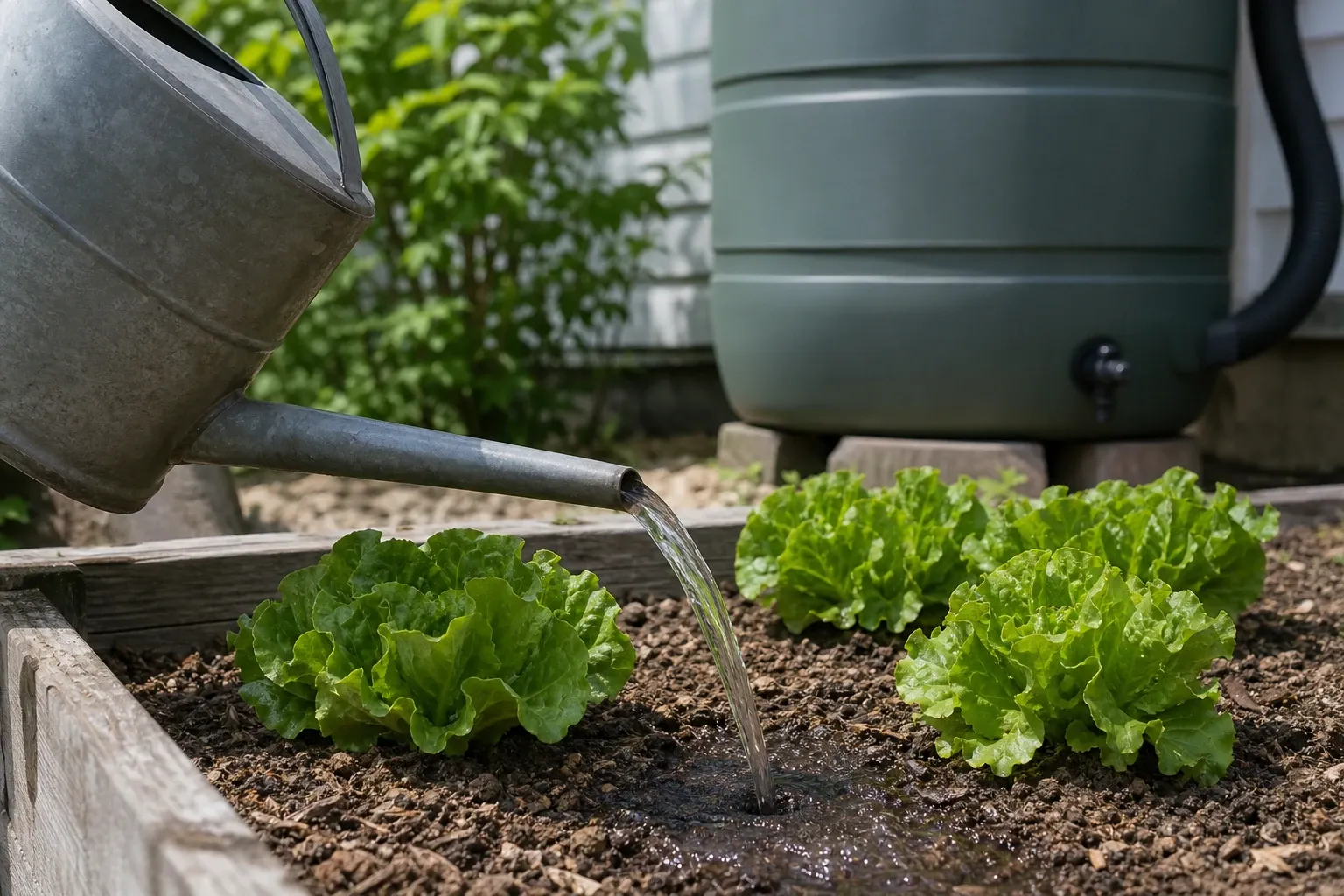
Garden use vs drinking use
Irrigation needs very little: screened, first-flushed water from a suitable roof is fine for ornamental plants and lawns. For vegetables, water the soil rather than leaves you’ll eat raw. Potable water, meaning safe to drink, needs a full treatment chain.
Boil, filter, disinfect: what each step does
- Sediment filter: catches grit and particles so later steps work better.
- Disinfection: UV light or chlorine kills germs.
- Boiling: kills germs.
Boiling, bleach and ordinary filters deal with germs or particles. They do not remove metals or chemicals from roofing, coils, solder, fuel or containers not made for food. If your water may be chemically contaminated, use another safe supply and follow your local health department’s guidance.
For a long-term drinking setup, use treatment certified for the specific contaminants in your water, and have it tested by a certified lab. Repeat the testing over time and after any change, since one good result doesn’t prove the water stays safe. Your local health department can point you to a lab.
Pump and backflow prevention for indoor use
Indoor use, like toilet flushing, needs a pump, a pressure tank and backflow prevention so rainwater can’t mix with the public supply. The DOE notes that potable systems at facilities need a licensed operator for maintenance, a sign of how much upkeep drinking-grade systems take.
What does a system cost, and what are the downsides?
A rainwater system can cost under a hundred dollars for a single barrel or many thousands for a treated whole-house setup. These are rough estimates; local prices vary widely.
Budget tiers: barrel, mid-size tank, whole-house system
| Tier | Rough cost estimate | What you get |
|---|---|---|
| Rain barrel kit | About $50 to $250 | One barrel, diverter, spigot |
| Mid-size tank | About $1,000 to $4,000 | 500 to 2,500 gallon tank, pad, screens, diverter, maybe a pump |
| Whole-house system | Often $10,000 or more | Cistern, pump, filtration, UV, plumbing, permits |
Payback and water bill savings
Payback is usually slow where water is cheap. The DOE points out that higher water rates make projects more worthwhile. A yard that needs heavy summer watering in a high-rate area sees the fastest return; a small barrel mostly pays off in convenience and healthier plants.
Honest downsides
- Water quality risk if screens, diverters or tanks are neglected
- Regular maintenance, including tank cleaning
- High cost for potable treatment and testing
- Space and weight of large tanks
- State, local or HOA limits
- Freeze damage in cold winters
Skip it, or stay at one barrel, if you have little roof drainage access, very low rainfall, no time for upkeep, or cheap, plentiful water and a small yard.
How do I maintain the system through the year?
The DOE says rainwater systems need regular operation and maintenance, and with that upkeep, tanks and pipework are built to last, often with makers’ warranties of 15 to 30 years, and 2 to 10 years for pumps. In practice that means a few minutes of checks each month and a deeper clean once or twice a year. Most problems start with clogged gutters or screens.
Seasonal maintenance checklist
- Spring: clean gutters, reattach diverters, check screens and seals for gaps.
- Summer: look for mosquito larvae and algae; empty the first flush diverter after storms.
- Fall: clear leaves weekly under trees; check that overflow drains away from the house.
- Winter: drain and store barrels, drain exposed pipes, and protect or lower larger tanks before long freezes.
- Yearly: scrub the tank, check pump and filters, and retest drinking water with a certified lab.
Quick tip: Mark filter change dates on the tank with a paint pen so nobody has to guess.
If you plan to drink the water, set your test and filter schedule before the first storm, and call your local health department with any questions about results.
Every guide on this site
Water from air
- Water from air: the basics
- How they work
- Methods and machines
- Building your own
- Solar-powered DIY build
- Without electricity
- AWG vs dehumidifier
- Is dehumidifier water drinkable?
Choosing a unit
- Water Freedom System review
- Best units for home
- Countertop units
- Budget options
- Solar-powered units
- Altitude Water T-12
Rainwater
Emergency storage
Off-grid water
Questions people ask
Can I collect rainwater if I live in an HOA?
Often yes, but your HOA can set rules on tank placement, color, size or screening from the street. Some states limit how far HOAs can ban rain barrels. Read your covenants and ask the board in writing before you install anything, especially a large tank visible from the road.
Is rainwater good for vegetable gardens?
Rainwater works well for most gardens because it is soft and free of added chlorine. For vegetables, use runoff from a roof whose materials and coatings won’t add chemicals, keep the first flush diverter working, and water the soil rather than leaves you will eat raw. Skip runoff from treated wood, asphalt shingles or old painted surfaces.
How long can I store rainwater?
Rainwater for the garden can sit for weeks or months in a sealed, opaque, screened tank. Quality drops if light, debris or mosquitoes get in. Using and refilling the water regularly keeps it fresher. Water meant for drinking should be treated right before use, not just when it goes into the tank.
Do I need a pump for a rainwater system?
A single raised barrel can feed a hose by gravity, though pressure is low. You need a pump for drip irrigation over distance, sprinklers, buried cisterns or any indoor use. Plug-in pumps are simple; hardwired pumps and indoor plumbing should be installed by a licensed electrician and plumber.
Can I use a dehumidifier to make water when it is not raining?
Dehumidifier water is not drinking water as collected. It can go on ornamental plants or be used for cleaning or flushing, but its coils, pans and plastics are not made for drinking water, and boiling or a household filter will not remove metals or chemicals they may add. For drinking, use stored safe water or a purpose-built drinking-water generator.