Some links on this page are affiliate links: we may earn a commission if you buy, and your price doesn't change. Details
Alongside stored water and a plan for treating it, some households add a home-built water-from-air unit as an extra source.
See the Water Freedom System guide on the official site60-day money-back guarantee
How much water can my roof collect? (Catchment math)
Your roof can collect about 0.623 gallons for every inch of rain on every square foot, minus losses to splash, wind and overflow. That one number lets you size everything else.
The formula
The formula is: gallons = roof footprint (sq ft) x rainfall (inches) x 0.623 x efficiency. Use 0.75 to 0.9 for efficiency. The lower end suits rough roofs and leaky gutters; the higher end suits smooth metal and tight gutters.
Measure the footprint, meaning the flat area the roof covers when seen from above. Don’t measure the sloped surface. Multiply the length of the building’s drip edge by its width.
Worked example: a 1,000 sq ft roof
| Step | Value |
|---|---|
| Roof footprint | 1,000 sq ft |
| Rainfall | 1 inch |
| Conversion number | 0.623 |
| Efficiency | 0.8 |
| Result | 1,000 x 1 x 0.623 x 0.8 = about 498 gallons |
That fills nine 55-gallon barrels with a little left over, so you would need ten barrels to hold all of it from a single inch of rain. So one storm can overwhelm one barrel fast. Look up your local monthly rainfall to see which months are wet and which are dry. Those months tell you how much tank you need.
Quick tip: If you only collect from one downspout, use only the roof area that drains to it. Count your own downspouts and split the roof area by how many you have.
What parts do I need? (Parts list for a small system)
A small system needs gutters, a downspout, a leaf screen, a first-flush diverter, a lidded barrel or tank, mosquito mesh, an overflow hose, a spigot and a stand. Prices below are rough ranges that vary by store and region, not quoted figures.
| Part | What it does | Rough budget |
|---|---|---|
| Gutters and downspout | Move roof water to one spot | Often already on the house |
| Leaf screen | Keeps leaves and grit out | Low |
| First-flush diverter | Sends the dirtiest first water away | Low to moderate |
| 55-gallon food-grade barrel | Stores water | Moderate each |
| Mosquito mesh | Blocks egg-laying | Low |
| Overflow hose | Carries extra water away | Low |
| Spigot or bulkhead fitting | Draws water out | Low |
| Stand (blocks or timber) | Lifts barrel for flow | Low to moderate |
A one-barrel setup is the cheaper path. A multi-barrel setup costs roughly the barrel price times the count, plus linking fittings.
Catchment and gutters
Your catchment area is the roof, and the gutters carry its water to the downspout. Gutters should slope gently toward the downspout and stay free of debris. A leaf screen on top saves a lot of cleaning.
First-flush diverter
A first-flush diverter catches the first bit of runoff, which carries the most dust, droppings and grit. Once its chamber fills, cleaner water flows on to the barrel. It suits anyone who wants cleaner water in the barrel, even for gardens.
Storage barrel or tank
A food-grade barrel is made from plastic meant to hold food or drink, so it’s less likely to leach chemicals. Choose opaque, lidded containers to limit algae and mosquitoes. Skip barrels that held pesticides or unknown chemicals. For bigger needs, see our guide to water tanks for rainwater harvesting, which also covers a cistern (a large storage tank).
Overflow, screens and outlet
The overflow is an opening near the top that lets extra water leave safely. Fit it with mosquito mesh (a mosquito screen) and run the hose well away from your foundation. Put the spigot a few inches above the barrel floor so sediment stays behind.
How do I build it step by step?
You build it in six steps, and the order matters because a full barrel is heavy and hard to move.
- Check local rules and your roof. Some states limit collection, and some roofs (see below) aren’t good sources. Our page on whether rainwater harvesting is illegal gives a state overview.
- Clean the roof and gutters. This clears old debris so it can’t wash into your barrel.
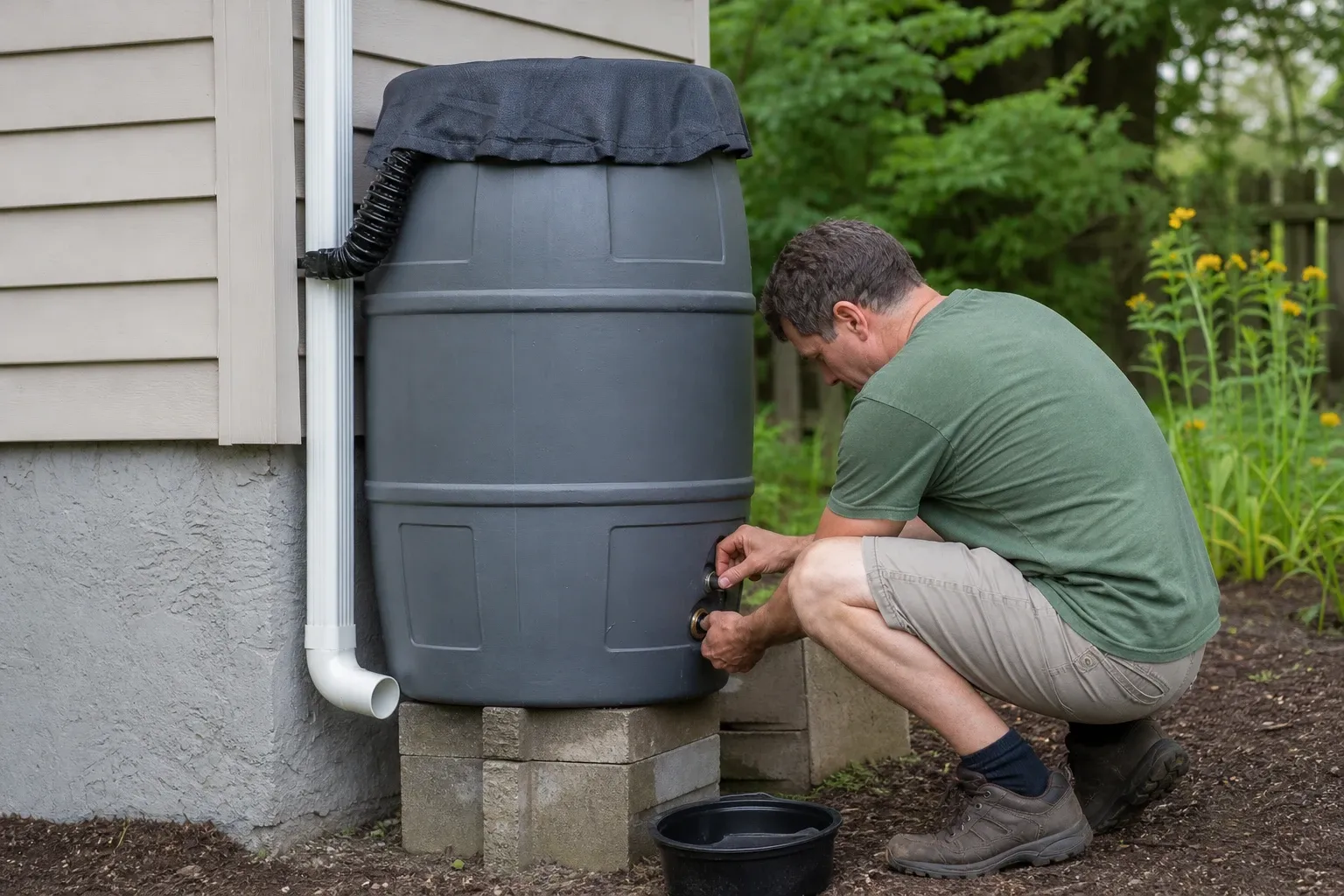
- Set a level, sturdy stand. A full 55-gallon barrel weighs about 460 lb, so use solid blocks on firm, level ground.
- Fit the downspout diverter and first-flush device. Cut the downspout to match, following the product’s instructions.
- Connect the inlet through a screen, add the overflow. Point the overflow away from the foundation.
- Install the spigot and test with a hose before rain. Fill the barrel from a hose and look for drips.
This suits anyone with basic hand tools. Skip any step that needs electrical work, and hire a licensed pro if you want a pump wired in.
How big should my storage be?
Your storage should match what you use, up to what your roof can supply during your longest dry stretch.
Matching supply to demand
Compare the yield from the math with your use. For example, if you water a garden with 40 gallons a week and your dry stretch lasts four weeks, you need about 160 gallons, or three barrels. A barrel that holds less than the yield simply overflows in a big storm, which is fine if the overflow is directed well.
Linking barrels together
Link barrels at the base with a short pipe or hose fitting so they fill and drain evenly. Keep them on the same level stand. Add an overflow only on the last barrel in the chain.
Can I drink rainwater from my system?
No, rainwater from a DIY barrel isn’t drinking water as collected. Roof runoff can carry bacteria, bird droppings and roof residues.
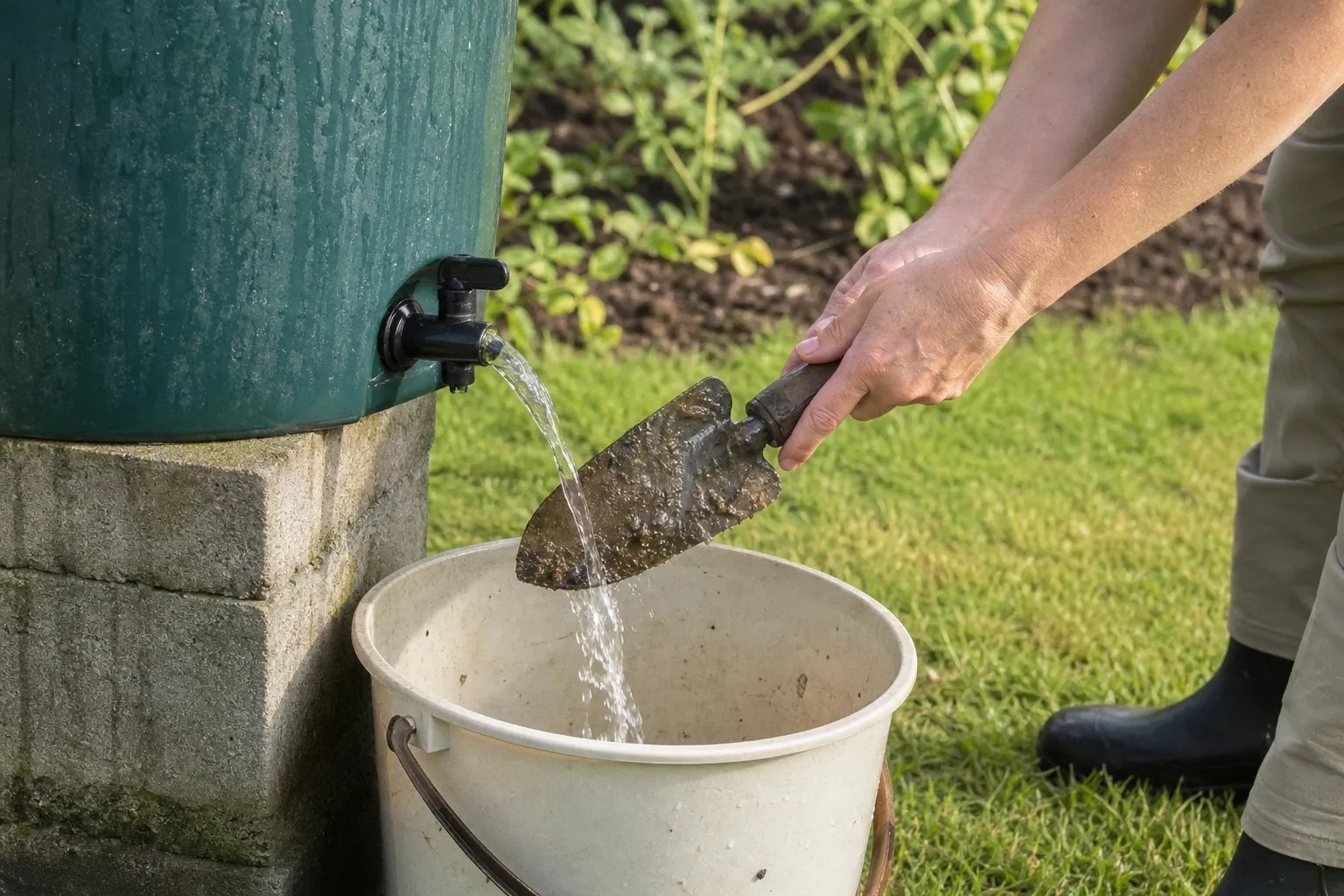
Use it for gardens, washing tools and other non-drinking uses. Boiling, bleach and ordinary filters deal with germs or particles. They do not remove metals or chemicals, such as those from roofing, solder, fuel or non-food-grade containers. Where your water may be chemically contaminated, use another safe supply and follow your local health department’s guidance.
For a long-term drinking setup, choose treatment certified for the specific contaminants you have, and have the water tested by a certified lab. Repeat the testing over time, because one result is not ongoing proof. Our guide to a filter for rainwater harvesting compares options.
Avoid collecting from treated wood shake roofs or old roofs with lead flashing. Those can add chemicals that filters and boiling don’t remove. If your roof is one of these, keep the water for non-edible plants or skip collecting.
How do I maintain it and avoid problems?
Maintain the system with a quick check each season: clean the gutters and screens, empty the first-flush chamber, and inspect lids and mesh.
- Mosquitoes and algae: Keep lids sealed and the barrel out of light.
- Freezing: Drain the barrel or disconnect it before winter. Ice can split a barrel and fittings.
- Warning signs: A bad smell, thick sediment or damp spots on the stand mean it’s time to clean and check for leaks.
A yearly full rinse keeps sludge from building up. Tilt the barrel or open a low drain, then scrub with a mild soap and rinse well.
Where does this fit in a wider water plan?
A barrel system is the first step in the bigger picture covered in our rainwater harvesting system guide for homeowners. It works for gardens and backup non-drinking water. If you’re also curious about making water from humid air, the atmospheric water generator page explains how that differs, since it makes much less water than a roof does on a rainy day. Water collected from a dehumidifier or a home-built condenser is not drinking water as collected either.
Questions people ask
Is it legal to collect rainwater where I live?
In most US states it’s allowed, but some limit how much you can store or how you use it. Rules change, so check your state and local authority before you build. Our state overview page lists what to look for.
Can I use any barrel for rainwater?
No. Use a food-grade, opaque barrel with a lid. Avoid barrels that held pesticides, motor oil or unknown chemicals, because residue can stay in the plastic and leach into the water. Wash a used barrel well before first use.
How long can I store rainwater?
Stored in a sealed, dark, clean barrel, rainwater for garden use can keep for weeks to months, though smell and algae can appear sooner in warm weather. Drinking use needs proper treatment and testing first, whatever the storage time.