Some links on this page are affiliate links: we may earn a commission if you buy, and your price doesn't change. Details
Water Freedom System: A $39.69 step-by-step guide (PDF and videos) to building a home water-from-air unit around a store-bought dehumidifier, plus four bonus books.
See the Water Freedom System guide on the official site60-day money-back guarantee
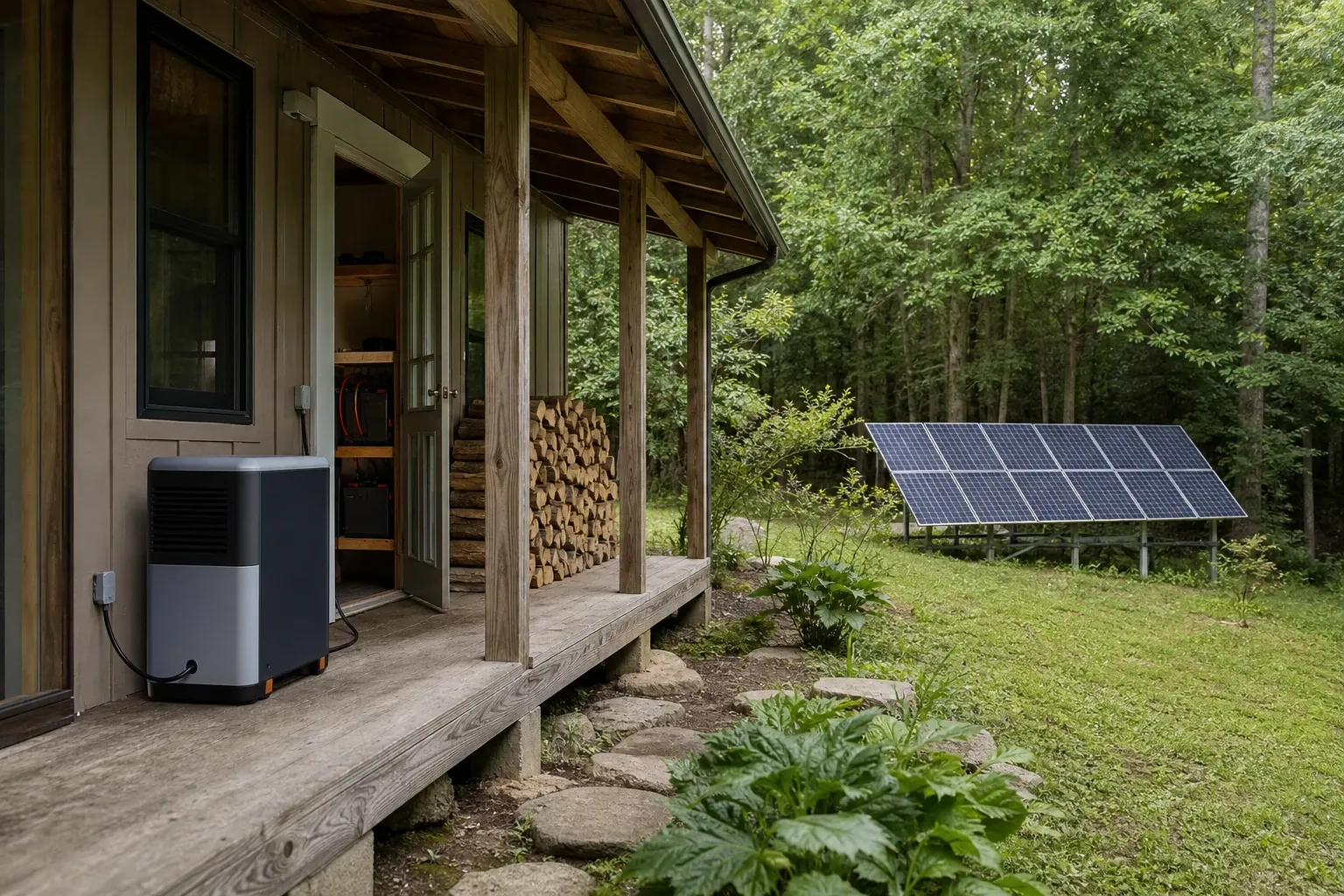
Do atmospheric water generators actually work off-grid?
An atmospheric water generator works off-grid if you can power it yourself and the air holds enough moisture. Without both, it makes little or nothing.
How a machine turns air into water
A fan pulls air over a cold coil, and the air drops its water as droplets, which run into a tank. This is condensation, and the temperature where it starts is the dew point. It’s the sweat on a cold glass, done on purpose and in volume.
The water still needs filtering, and often UV light (UV sterilization) before drinking. Some units also add minerals (mineralization), which is mostly for taste, not a required safety step. Finished drinking-water units treat their own water, so follow the maker’s filter schedule.
Boiling, bleach and ordinary filters deal with germs or particles. They do not remove metals or chemicals, such as those from roofing, coils, solder, fuel or non-food-grade containers.
Why the process is energy-hungry
Cooling air takes a lot of electricity, because the machine chills far more air than it turns into water. Off-grid, you make every watt yourself.
How much water can one make, and what changes it?
Output depends mostly on humidity and temperature, and brand figures are best-case numbers, not promises. Daily output is usually listed in liters or gallons per day, so compare that number at the humidity you actually have.
Humidity and temperature: the two dials
Relative humidity (RH) is how full the air is, as a percentage. Warm, humid air gives the most water. Cool, dry air gives the least. The National Weather Service has plain explainers on humidity and dew point if you want the basics.
Humidity cutoffs vary by model
Cooling-coil machines make less as the air gets drier, and the minimum humidity differs from model to model. Look up the rated range for the unit you’re considering, and check your local numbers for the driest month, not the average.
Quick tip: If your air stays very dry for months, skip compressor units and look at rain and storage first.
Output by climate and season
| Climate | Typical humidity | What to expect |
|---|---|---|
| Gulf Coast, Southeast | Often high | Usually the best output, but it still shifts with season and heat |
| Pacific Northwest | Moderate to high, cool | Moderate, drops in cold |
| Desert Southwest | Often low | Very low for coil units |
No region guarantees year-round output.
Desert claims need caution. MIT researchers built a power-free panel that collected up to 160 milliliters a day in Death Valley. That’s about two-thirds of a cup, a lab-stage result, not a household supply.
What power does an off-grid unit need?
An off-grid unit needs steady power, so size your panels and battery from its watts and run hours.
Watts, kWh per liter and solar sizing
Here’s a worked example with made-up round numbers.
| Step | Math | Result |
|---|---|---|
| Daily energy | 600 W x 8 hours | 4.8 kWh |
| Sun hours | About 5 per day | 0.96 kW of panels before losses |
| Allow for system losses | 0.96 / 0.75 | Roughly 1.3 kW of panels |
Check your own unit’s label for real watts.
Compare that with hauling water. One trip with a few 5-gallon jugs can beat a solar array on pure cost.
Running on solar, batteries or a generator
Solar alone only runs it in daylight, so a battery adds cost. A generator works but burns fuel and adds noise. Compressors draw a surge at startup, so check the inverter’s surge rating. Wiring beyond plug-in parts is a job for a licensed electrician.
RV and outdoor use
RVs have tight power budgets, and outdoor units face heat, dust and vibration. Most RV owners will do better with a tank and a good filter. For solar-specific options, see solar powered atmospheric water generator comparisons.
What are the disadvantages of an atmospheric water generator?
The main drawbacks are cost, energy use, upkeep and low output in dry or cold air.
Cost of ownership in one place
Add the purchase price, filter replacements and a year of electricity. A 4.8 kWh day at your local rate shows the electric part fast. Prices vary a lot by model, so get the maker’s current figures.
Noise, filters and cleaning
Compressors hum and give off heat. Tanks and coils can grow mold if neglected. The intake air filter (often a MERV-13 filter) needs regular changes.
Contaminant and safety limits
Air carries dust, PFAS (long-lasting industrial chemicals) and microplastics, and condensed water isn’t automatically safe. Don’t assume a unit removes PFAS or lead; ask for the maker’s test data for your model. If your water may be chemically contaminated, use another safe supply and follow your local health department’s guidance. For a long-term drinking setup, choose treatment certified for the specific contaminants you’re worried about, and have the water tested by a certified lab. Repeat the tests over time, because one result isn’t ongoing proof. Against bottled water, a unit cuts plastic waste, but only if it runs enough to matter.
Can I make a DIY atmospheric water generator without electricity?
Yes, but no-power methods yield very little, far short of a household’s needs.
Passive dew and fog collectors
Mesh fog nets and dew sheets work only where fog or dew is frequent. Expect cups on many days, though a fog collector at a good site can yield more than that. Our guide to making water from air without electricity covers what works.
Dehumidifier-based builds
A dehumidifier-based build still needs electricity. Its condensate is not drinking water as collected. Use it for plants, cleaning and flushing. Boiling or a household filter doesn’t remove metals or chemicals the parts may add.
The Water Freedom System is a step-by-step guide (PDF and videos) to building your own unit. The maker says it can make up to 60 gallons a day, but the guide itself gives no output figure.
See what the guide covers and the 60-day refund terms on the official site.
See the Water Freedom System guide on the official site60-day money-back guarantee
How does it compare with rainwater, wells and other off-grid sources?
Rainwater usually gives far more water per dollar than air-water, where rain falls.
| Source | Power need | Cost level | Reliability |
|---|---|---|---|
| Air-water unit | High, steady | High | Good if humid |
| Rain tanks | Low | Lower | Depends on rainfall |
| Hauled water | None | Ongoing | Depends on supply |
Rainwater harvesting and treating it
You can make rainwater safer to drink by filtering, then disinfecting. The EPA explains how to disinfect water with boiling or bleach. Those steps handle germs, not metals or chemicals from roofing or containers. See off-grid water purification for more.
Storage and hauled water
For emergencies and disaster relief planning, the CDC advises at least 1 gallon per person per day for 3 days, ideally 2 weeks, replaced every six months. Air-water works best as a backup layer where humidity is steady.
Which setup fits my home? A step-by-step sizing check
Four quick checks tell you whether air-water, rain or storage fits your home.

- Daily need: plan about 1 gallon per person for drinking and cooking.
- Humidity: find RH for your driest season. If it’s below your model’s rated range, lean on rain or storage.
- Power: list the watts and sun hours you can really supply.
- Choose: ready-made unit, DIY build, or rain and storage.
Makers like Watergen, Altitude Water and Spout are named for orientation, not endorsement. Compare their published specs yourself.
Where does this fit in the bigger picture?
An off-grid unit is one piece of a wider plan. Our atmospheric water generator hub explains the types, and the off-grid water supply system overview shows how air-water sits next to rain, storage and treatment.
Questions people ask
Does an atmospheric water generator work in the desert?
Coil-based units make very little in dry desert air, and the humidity they need varies by model. Passive lab devices have worked in dry air but at tiny volumes, like a few hundred milliliters a day. Rain tanks or hauled water suit deserts better.
Can an atmospheric water generator run on solar power?
Yes, if panels and batteries cover its watts and run hours. A 600-watt unit running 8 hours needs about 4.8 kWh a day, which means a sizable array. Check your unit’s label and your local sun hours before buying.
Is a dehumidifier the same as an atmospheric water generator?
They use similar cooling, but a dehumidifier isn’t built for drinking. Its coils, pan and plastics may add metals or chemicals. Its condensate is not drinking water as collected, so use it for plants or cleaning.