Some links on this page are affiliate links: we may earn a commission if you buy, and your price doesn't change. Details
Alongside stored water and a plan for treating it, some households add a home-built water-from-air unit as an extra source.
See the Water Freedom System guide on the official site60-day money-back guarantee
How much emergency water do I need to store, and in what size containers?
A household needs at least 1 gallon of stored water per person per day, and container size decides how easily you can store and move it.
Gallons per person per day
The CDC recommends at least 1 gallon per person per day, enough for 3 days, and a 2-week supply if you can manage it. Add more for pets, hot weather, and cooking.
Example: a family of four for two weeks needs 4 people x 14 days x 1 gallon = 56 gallons. That’s one 55-gallon barrel plus a jug or two, or about twelve 5-gallon jugs.
Why container size matters more than you think
Water weighs about 8.3 pounds per gallon, so a full container is heavier than it looks. A 5-gallon jug is about 42 pounds. A 55-gallon barrel is about 456 pounds, plus the barrel.
Big containers are cheap per gallon but can’t be carried. Small ones cost more per gallon but you can lift them, stack them and take them with you.
Quick tip: If you can’t comfortably lift 40 pounds, look at smaller 2 to 3 gallon containers.
Which water storage container type fits my home? (comparison table)
Jugs, barrels, cans and tanks each suit a different space and budget. The table gives typical ranges, not quotes, so check current prices where you shop.
| Type | Typical size | Material | Stacks? | Weight full | Cost per gallon (rough) | Best use |
|---|---|---|---|---|---|---|
| Jugs / stackable blocks | 3.5 to 7 gal | HDPE plastic | Yes, most designs | 30 to 58 lb | Moderate | Apartments, rotation |
| 55-gallon barrel | 55 gal | HDPE plastic | Not safely, usually one high | About 456 lb plus barrel | Lowest | Garage, basement |
| Cans, pouches, bottles | 4 oz to 1 gal | Metal, foil, PET | Yes | Light | Highest | Bags, vehicles |
| Tanks, cisterns | 100 gal and up | Poly, fiberglass, steel | No | Very heavy | Low at scale | Rainwater, long term |
Jugs and 5-gallon containers
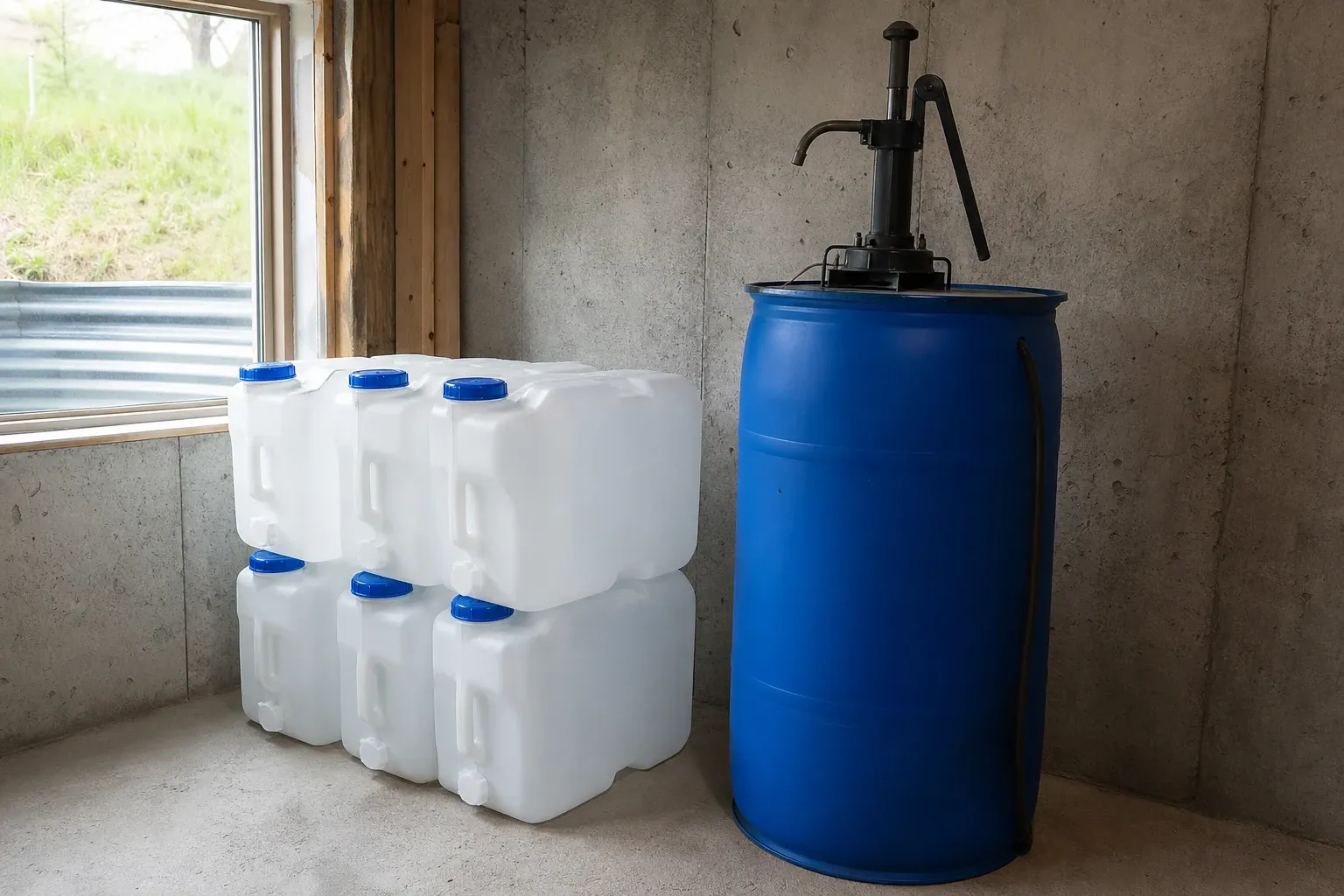
A 5-gallon jug is the easiest first step. It’s light enough to carry, and many stackable designs, such as WaterBrick, interlock so they save floor space.
They suit apartments and anyone who wants to rotate stock one jug at a time. The limit is cost per gallon, which runs higher than barrels.
55-gallon barrels
A 55-gallon water barrel gives the lowest cost per gallon of the home-sized options. You’ll need a bung wrench (to open the caps) and a siphon pump to get water out, since you can’t lift it.
It suits a garage or basement with a sturdy floor. Skip it if you rent a small place or may need to move it.
Cans, pouches and bottles
Canned and pouched water is small and often sealed for a long shelf life, based on what the makers print on the package. It costs the most per gallon.
Use it for a car kit or go-bag, not as your main supply.
Larger tanks and cisterns
A water tank holds hundreds or thousands of gallons and suits rainwater or long-term home supply. It needs space, a level base and a plan for treatment. Our guide to emergency water storage tanks covers sizing.
What makes a container safe for drinking water?
A safe drinking water container is made of food-grade plastic, ideally HDPE, and has never held chemicals.
Food-grade plastic and HDPE
HDPE plastic (high-density polyethylene) is marked with a #2 recycling symbol. Look for a “food grade” label, BPA-free wording and opaque walls that block light, which slows algae growth.
Choose tight-fitting lids and clean the container with soap and rinse before filling.
Containers to avoid
Avoid anything that held chemicals, fuel or pesticides. Skip milk jugs, because milk residue is hard to wash out and the thin plastic breaks down. Thin single-use soda bottles are fine short term, but not for long storage.
A used barrel is only fine if you know it held food or drink, and you should clean it well.
Where should I put stored water, and how do I stack it?
Stored water keeps best somewhere cool, dark and away from chemicals, with weight spread across the floor.
Cool, dark and off the ground
Keep containers out of sunlight and away from fuel, paint and solvents, since vapors can pass through plastic. Protect them from freezing and leave a little air space for expansion. Set barrels on pallets or boards instead of bare concrete.
Stacking and weight limits
Stackable jugs save floor space, but a tall stack of full containers gets heavy fast. Spread weight across several spots, and keep heavy ones low. If you’re unsure about an upper floor, ask a licensed contractor about the load.
Garage, basement, closet or apartment
A basement stays cool and steady. A garage can freeze or overheat. In an apartment, use closet floors and the space under beds. Our bathtub emergency water storage page covers short-term extra capacity.
How do I fill, treat and rotate stored water?
Fill clean containers with tap water, label them with the date, and replace the water about every six months.
Filling from the tap
City tap water is usually already treated, so most people can fill clean containers straight from the faucet. If your supply is questionable, the EPA explains how to disinfect water with household bleach. Use plain, unscented chlorine bleach and follow its steps.
A water preserver is a store-bought additive some people use; follow the label.
Treating collected or questionable water
Rain or other collected water must be filtered and disinfected before you drink it. The CDC says boiling for 1 minute makes water safer, or 3 minutes above 6,500 feet. For well water, use a certified lab test.
If you collect rain, see our rainwater filtration comparison.
When to replace it
The CDC advises replacing stored water every six months. Write the fill date on tape on each container. Some makers print their own schedule, so follow that if it differs.
Quick tip: Set a phone reminder for spring and fall clock changes.
What if stored water runs out? Making water from air as a backup
Stored water has a limit, so some people add a second source such as rain catchment or dehumidifier water.
A dehumidifier pulls water from the air, but output depends on humidity and temperature, and it won’t help much in dry air. The water must be treated and tested before drinking. Our page on whether dehumidifier water is safe explains why.
The Water Freedom System is a guide (PDF, videos and an optional printed book) for building your own dehumidifier-based atmospheric water generator. It’s a build-it-yourself guide, not a machine. The maker says it can make up to 60 gallons a day, though the guide itself gives no output figure, and the maker hasn’t published independent output tests. Read our Water Freedom System review for details.
Which setup should I choose? A simple decision rule
Pick by space first, then lifting ability, then budget.
Apartment
Choose stackable 3 to 5 gallon jugs, plus a few cans or pouches. Store them in closets and rotate one at a time.
Suburban home
Mix jugs with one or two barrels in a basement or garage. Keep the jugs for carrying and the barrel as bulk supply, with a siphon pump and bung wrench stored beside it.
Homestead or off-grid
Use barrels or tanks linked to rain collection, with filtering and disinfection before drinking. Keep a few jugs for hauling.
How does this fit with the rest of your water plan?
Containers are one part of your emergency storage water plan, alongside treatment, rotation and a backup source. Start with the gallons you need, then match the container to your space.
If you’d rather hold a large reserve in one place, compare emergency water storage tanks. For a fast, low-cost boost before a storm, see bathtub emergency water storage. Both pair well with a few jugs.
Questions people ask
Can I reuse soda bottles for emergency water storage?
Clean PET soda bottles work for short-term water if you wash them well and fill them with treated tap water. They’re thin and can degrade, so they’re a poor pick for long storage. Don’t use milk jugs, since residue is hard to remove.
Is a 55-gallon barrel hard to move once full?
Yes. Water weighs about 8.3 pounds per gallon, so a full barrel is roughly 456 pounds before the barrel itself. Put it where it will stay, on a pallet, and use a siphon pump to draw water out.
Can I store water in the freezer?
Yes, in freezer-safe containers with room left for ice to expand. Frozen water is handy for keeping food cold and can be drunk once melted. It takes up space, so it works as a supplement, not your main supply.